What is exosome therapy, and does it work?
Published .
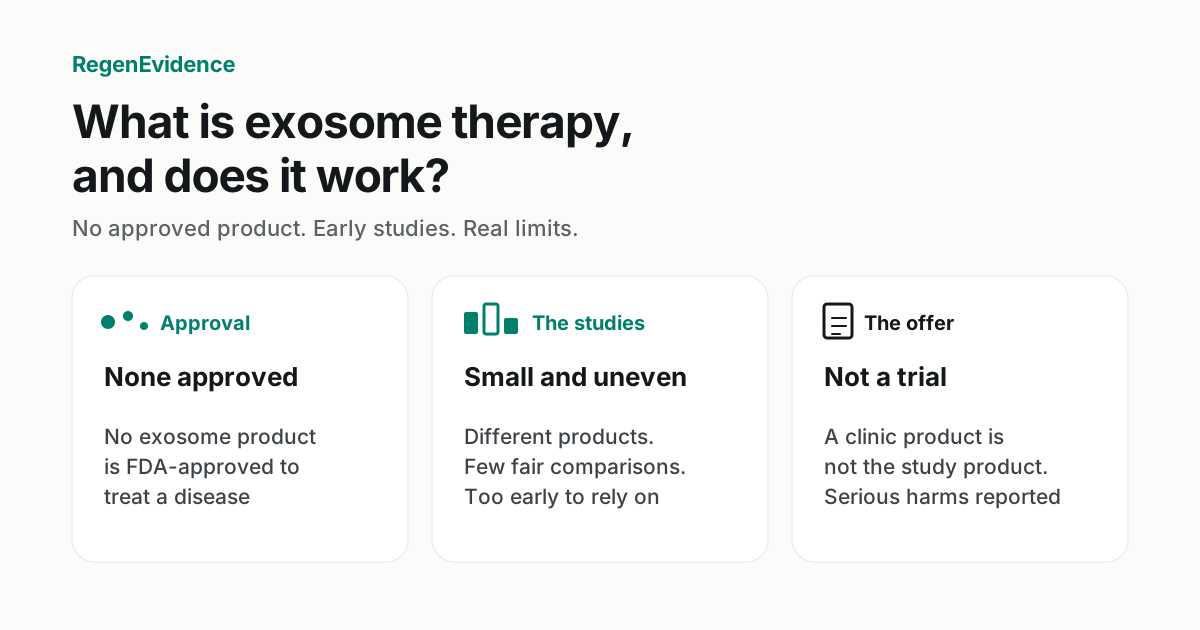
No exosome product is FDA-approved to treat a disease. Early human studies are small and uneven, and a clinic offer is not the same as a research trial.
The short answer
It has not been shown to help in a reliable way. No exosome product is approved by the FDA to treat a disease. Clinics and studies use the name for very different preparations, and a result for one product does not carry over to another.23
Exosomes are tiny particles that cells release. They are not cells, and they are not a ready-made repair treatment. Research teams are testing carefully prepared versions. Those studies are mostly small, the products differ, and most of them do not have a fair comparison group. A 2024 review said it is too early to conclude that these products help.16
A product a clinic injects or gives by vein is not the same as the product in those studies. Unapproved products marketed as exosomes have been linked to serious harm, including bacterial infections.25
What are exosomes?
Exosomes are one kind of extracellular vesicle. Extracellular vesicles are small particles that cells release. A fatty layer wraps them, and they carry proteins, fats, and pieces of genetic material. Cells use them to pass signals to other cells.16
You may also hear the names microvesicles or EVs. The words are not used the same way in every paper, and researchers still have a lot to learn about these particles.1
They are far too small to see. One description puts a typical vesicle at about 30 to 150 nanometers across. A nanometer is a billionth of a meter.9
Where do the products come from?
A product sold as exosome therapy is prepared. It is not a ready-made substance someone simply draws out and returns unchanged. In studies, the particles have come from cultured cells, including cells from bone marrow, fat, umbilical cord, placenta, or platelets. Some research products are altered in the lab. Some start from a person's own material.67
Conditioned medium is the liquid cells have been grown in. It contains many released substances, not only vesicles. In one skin review, 78 percent of the studies were of that liquid, and 21 percent were of extracellular vesicles. A clinic can say a product contains exosomes when the vesicles may not have been separated out.19
How it is given matters just as much. Studies have placed preparations on the skin, injected them, given them into a vein, or had people inhale them. A finding for a product put on the skin, or for an inhaled research product, does not show what an infusion into a vein will do.6
Using your own cells does not remove the risk. Once the material is handled in a lab, it can pick up germs. That can lead to infection or other unwanted effects, even when the starting material was yours.1
What are they offered for?
Being offered a product is not the same as a study showing it helps. A US public health page describes these products being used for arthritis, injury pain, and aging. Separate reviews cover studies in hair loss and in skin appearance. Those are different uses, and evidence for one does not answer the others.578
The FDA says there are currently no FDA-approved exosome products. Products intended to treat a disease or other condition generally need FDA approval before they are marketed. The FDA groups exosomes with other regenerative products and says that group is not approved for orthopedic problems such as knee arthritis, for neurologic diseases, or for chronic pain or fatigue.23
A research study tests one defined preparation, for one question, with a plan for follow-up. A clinic offer that lists many unrelated problems is a different thing. A product tested for one condition is not shown to help, or to be harmless, for another.14
What does the research show?
A 2024 review looked for human treatment studies published through the end of 2023. It included 21 studies and 335 people. Products, doses, and illnesses differed widely. Most studies had no comparison group, so a change could have come from other care, or from time. The reviewers said it is too early to conclude that these products help. In one study of 11 people, platelet vesicles did not make a skin wound made for the study heal faster than a comparison solution. Every wound had closed by day 30.6
For hair loss, a 2025 review searched through May 10, 2025, and found 11 studies with 298 people. Only two assigned people by chance. The rest included single-patient reports. Each study reported improvement on at least one hair measure. Without a comparison group, that is not proof the product caused it.7
The clearest hair comparison was a 12-week pilot in 20 men. Ten received a preparation that combined plant extracts with exosomes, and ten received a placebo, a comparison without that preparation. The middle value was a gain of 9.5 hairs with the preparation and 1.5 hairs with placebo. That small, short study does not show that a clinic injection will regrow hair. The reviewers said the studies were too different, and often too short, to set a standard treatment or to rule out later harms.7
For skin, a 2025 review searched through July 2025 and found six studies with 99 people. They could not be combined. Some were reports about one person. The randomized studies had problems in how they were run, including unclear assignment and a lack of blinding. Many products were used with a laser or with needling, so the exosomes were not tested alone. Side effects were mostly mild and brief. Follow-up was often weeks.8
A second skin review, searched through September 19, 2024, included 19 studies and 624 people. In that review, 78 percent of the studies were of conditioned medium, the culture liquid, and 21 percent were of extracellular vesicles. The studies were small and short. Later immune reactions and unintended tissue changes are still unknown. Improvements in that mix of products are not proof that an exosome injection helps skin.9
The 2024 review did not include a knee-arthritis trial. The FDA says these products are not approved for orthopedic conditions.36
What are the risks?
Infection and contamination are real risks. Particles handled outside the body can pick up bacteria, viruses, or other impurities, even when the starting material was your own. Regulators have already reported harm of that kind.12
In December 2019, the FDA reported that patients in Nebraska had serious adverse events, including bacterial infections, after treatment with unapproved products marketed as containing exosomes.25
The FDA has also received reports of serious harm from unapproved regenerative products, a group that includes exosomes. Those reports include life-threatening blood infections and unwanted immune reactions. For some products in that wider group, reports also include tumors and blindness. The reports show that serious harm happens. They do not give one risk number for every product.4
Research studies show a narrower picture. In the 2024 review, 6 of 335 people had a serious adverse event. The pooled figure was 0.7 percent, with a likely range from 0.1 percent to 5.2 percent. Other adverse events were pooled at 4.4 percent, but the likely range was wide, from 0.7 percent to 22.2 percent, and studies did not record side effects in the same way. Those people received early research products. The numbers do not describe a product sold outside that research, and follow-up in the hair and skin studies was often too short to catch later harms.678
There is also no standard product. Studies isolated and measured particles in different ways, and they did not use the same dose units. Two offers with the same name can be different preparations. An unproven product can also delay care that is already used for your condition, and it may keep you out of a later trial.126
What does regulation mean?
In the United States, the FDA regulates exosome products that are meant to treat a disease or other condition. They are regulated as drugs and biological products, and they need FDA approval before they are marketed for that use. The FDA says that no exosome product is approved.23
Before approval, these products need FDA oversight in a clinical trial.4 Ask whether the FDA has reviewed the treatment. Ask for the investigational application number, called an IND, and for the FDA letter that acknowledges it. Ask even if you are told the product comes from your own body. A listing on ClinicalTrials.gov, or a claim that a company registered a product with the FDA, does not mean the product is approved.245
That approval rule is about products intended to treat a disease or other condition.23 Under US law, whether a product is a cosmetic or a drug depends on its intended use, including the claims made for it. Cosmetics do not need FDA approval before they are sold, so a cream sold only to change appearance is regulated differently from an injection or an infusion offered as treatment.12 A cosmetic label does not prove that the bottle holds a defined vesicle dose, or that it will change your skin.1
Treatment given in another country is outside FDA oversight. The FDA usually has little information about those clinics or their products. A research society wrote in 2020 that, as of June of that year, it knew of no approved exosome therapy. Rules in other countries can differ.12
What about cost and insurance?
There is no single price. These products are still experimental.12 A patient guide on experimental cell treatments says that, in most cases, insurance companies and government health programs do not cover experimental treatment. Ask your own plan about the exact procedure before you agree to it. Do not assume it will pay.10
Many of these offers are expensive. A high price is not proof that the product will help.1
Ask whether you have to pay. Be wary if a clinic calls the offer a patient-funded trial. In the usual setup for responsible research on an experimental cell treatment, the participant is not charged for the experimental treatment and the monitoring that goes with it.510
How can I tell a trial from a paid offer?
A clinical trial is a research study of a potential treatment. People volunteer. You should receive a consent form that explains the goal, the steps, the risks, and the possible benefits. You can change your mind after the study has started. In a trial that assigns people by chance, not everyone receives the experimental product. The experimental treatment may not help, or may not help more than usual care.11
A paid service can be labeled a study without being that kind of trial. Ask for the IND number and the FDA acknowledgment before you are treated. A claim that there is no risk is a warning sign, and so is a pitch that rests only on other patients' stories. Talk with your own doctor before you enroll or pay.12511
What else should I compare it with?
The useful comparison is the care already used for your condition, not a different exosome product. For pattern hair loss, a review of exosome studies names minoxidil, finasteride, and hair transplantation as treatments that are already available. An exosome study does not replace a conversation about those options.7
For a painful joint, the FDA says exosome products are not an approved treatment. The comparison is the care already used for that joint problem.3
The FDA also warns that an unproven product can delay treatment that is already on solid scientific ground. What that care is depends on the diagnosis. A doctor who knows the condition can name it.2
Questions to ask before you decide
What is the exact product, what cells or fluid did it come from, and was it tested for contamination?16
Is it FDA-approved for my condition? If not, what is the IND number, and can I see the FDA letter that acknowledges it?25
Is this a research trial? Will I pay? Can I read the consent form, and can I leave?41011
What have studies shown for my condition, against a fair comparison, and for how long were people followed?67
What problems have been reported, including infection, and who treats me if something goes wrong?24
What is the usual care for my condition, and what do I delay if I do this instead?27
Will insurance pay any of it, and what is the full charge if it does not?10
The bottom line
Exosome therapy is not an FDA-approved treatment. The human studies so far are too small and too uneven to show that a clinic product helps. Those products are not the same as research preparations, and unapproved products have caused serious harm.236
Talk with a doctor who knows your health history before you consider one. This article is for general education. It is not medical advice.1
Sources · 12
- 1Source 1(opens in a new tab)
Patient notice · 2020
- 2Source 2(opens in a new tab)
Regulator page · 2019
- 3Source 3(opens in a new tab)
Regulator page · 2020
- 4Source 4(opens in a new tab)
Regulator page · 2021
- 5Source 5(opens in a new tab)
Public health page · 2019
- 6Source 6(opens in a new tab)
Research review · 2024
- 7Source 7(opens in a new tab)
Research review · 2025
- 8Source 8(opens in a new tab)
Research review · 2025
- 9Source 9(opens in a new tab)
Research review · 2025
- 10Source 10(opens in a new tab)
Patient guide
- 11Source 11(opens in a new tab)
Patient page · 2024
- 12Source 12(opens in a new tab)
Regulator page
Ask a question in your own words. A question stays on the ask page. It is not added to this article or to a share link.
For learning only. Not medical advice. Talk to your doctor.