What is a PRP facial, and does it work?
Published .
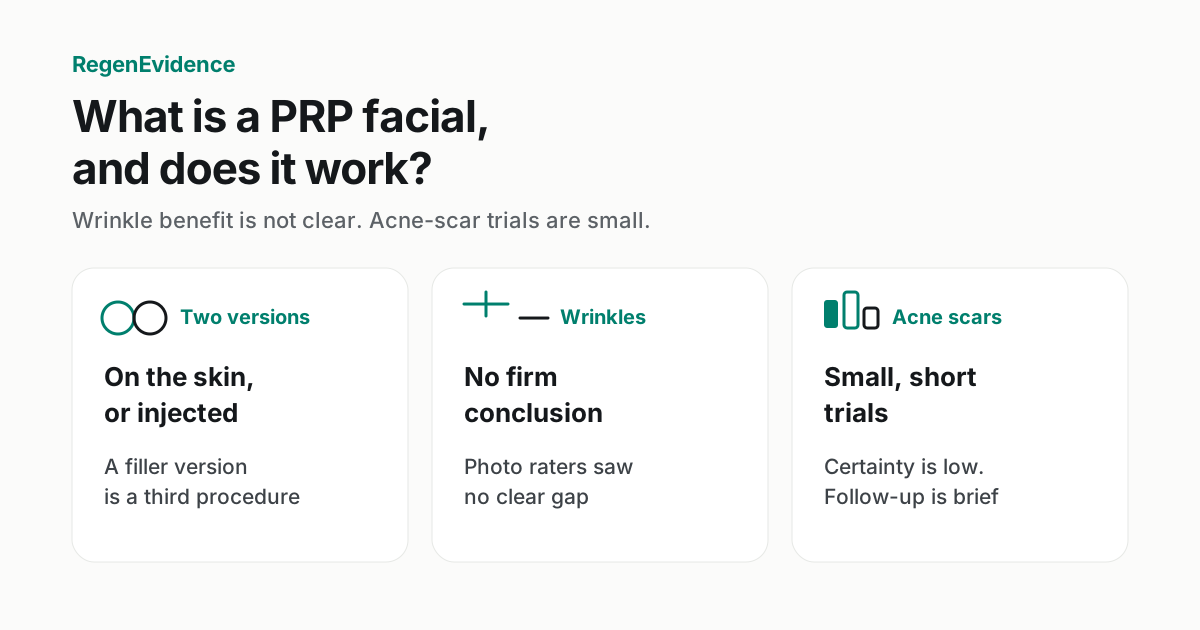
A PRP facial puts your own platelet-rich plasma on the face, often after tiny needle pricks. Wrinkle benefit is not clear. Acne-scar trials are small.
The short answer
Not clearly. A PRP facial uses platelet-rich plasma, a portion of your own blood that has more platelets than the sample it came from. Platelets are small pieces in blood that help it clot. They also carry proteins called growth factors. The name is used for more than one procedure. In one version, a clinician spreads the plasma on the face after microneedling, a treatment that makes many tiny holes in the skin. In another, the plasma is injected. A third version adds injections of a gel filler.
People use these treatments for rough texture, fine lines, acne scars, and a fresher look. For wrinkles and general rejuvenation, reviews say the evidence is too weak for a firm conclusion. For acne scars, adding PRP to microneedling has looked better than microneedling alone in small studies, but that evidence is low or very low certainty.156
What a PRP facial is
Plasma is the liquid part of blood. A clinician draws blood, usually from the arm, and spins it in a centrifuge. That machine separates the blood into layers. The layer rich in platelets is the part used on the face.12
A hospital page describes the microneedling version this way: the plasma is spread on the face, and microneedling or tiny pricks help the skin take it in. That page says this version is aimed at the surface of the skin, including acne scars, fine lines, large pores, uneven color, and rough texture.1
The version with filler is a different procedure. It combines PRP injections with a hyaluronic acid filler, a gel used to add volume. The filler can make skin look fuller right away. That immediate change comes from the filler. It is not proof that PRP itself changed the skin.1
A dermatology page describes the same split for aging skin: the plasma can be injected, or it can be put on after microneedling. Some clinicians add a filler so the shape changes at once. There is no single recipe. In reviews of facial PRP, the number of treatments ran from 1 to 6. Almost every study injected the plasma. Only one study in that set put PRP on the skin, and it did so with a laser, not with microneedling.35
What people use it for
Clinics offer PRP facials for skin texture, fine lines, acne scars, and a more rested look. A hospital page lists acne scars, fine lines, large pores, uneven color, and rough texture. A dermatology page says some patients report fewer wrinkles, less sagging, and acne scars that look milder. Those are descriptions of use and of what some people notice. They are not a fair test against a comparison treatment.13
The same dermatology page says there is little evidence behind the demand. A hospital page says there is little evidence that PRP reduces wrinkles and other signs of aging. Being commonly offered is not the same as a proven benefit.34 A dermatology page calls it an unproven treatment.3
Wrinkles and rejuvenation
A 2024 overview gathered 13 reviews published from 2015 to 2023. Its search ran through November 2023. The reviews rested on 28 studies, and 18 of those 28 had no comparison group. Without a comparison, a study cannot show that PRP did more than time or ordinary care. Eight studies combined PRP with another treatment, such as laser, fat transfer, or filler. Twenty used PRP alone. The overview rated its confidence in 12 of the 13 reviews as low or critically low. It concluded that the evidence is not strong enough for a firm conclusion, whether PRP is used alone or added to something else.5
Only one of those reviews pooled a number for facial rejuvenation. In 3 trials, people who received PRP along with another treatment reported higher satisfaction than people who did not receive PRP. The average gap was 0.63 points on the satisfaction score those trials used, and the likely range ran from 0.25 to 1 point. The overview rated that evidence low, because the trials were at risk of bias and did not agree. Satisfaction is easy to sway when a person knows what they received.5
One randomized trial compared injected PRP with salt water. It did not use microneedling. Twenty-seven adults, ages 18 to 70, with sun-related cheek wrinkles on both sides were enrolled at an academic dermatology clinic. Nineteen were analyzed. The average age was about 46, and 17 were women. Each person received 3 milliliters of PRP in one cheek and salt water in the other, in a single session. Neither the person nor the people rating photos knew which cheek was which.8
At 6 months, two dermatologists looking at photos found no significant difference for fine lines, uneven color, roughness, or a yellow cast. The participants rated texture and wrinkles as more improved on the PRP cheek. On a 5-point scale, higher means more improvement. Texture averaged 2.00 with PRP and 1.21 with salt water, a gap of 0.79 points. Wrinkles averaged 1.74 and 1.21, a gap of 0.53 points. Both gaps are less than one point on that scale. Overall satisfaction was also higher for the PRP cheek. The authors said photos may miss a subtle change that the person can see, that several people left before the end, and that one session may be too few. They also noted that PRP might, in theory, affect the other cheek and shrink the gap. They said participants could still tell the cheeks apart, so that spread was not shown.8
A 2025 review looked at PRP used by itself, not with microneedling. It included 20 reports and 514 people. Those reports were controlled trials, studies that followed people over time, and small series with no separate comparison group. Sixteen compared treatment with a control or with the person's own starting point. Four compared it with a different treatment. These figures count studies, not people. It says a gain was reported in 80 percent of studies that measured skin thickness (5 studies), 75 percent for elasticity (6), 40 percent for wrinkles (16), 33 percent for texture (11), and 17 percent for uneven color (12). None of the 4 studies that measured hydration found a gain. Every study that asked about satisfaction said it rose. No serious harms were reported in those studies. A change from the starting point is not the same as beating a placebo. This review does not replace the 2024 overview.512
The 2024 overview also found that only 2 of 13 reviews had planned to count harms. Where harms were described, they were mostly brief pain, redness, and swelling. That is not a long-term safety record.5
Acne scars
Acne-scar research asks a different question. Most of it tests PRP added to microneedling, or to a laser, against the same procedure without PRP.6
A 2023 overview of 15 reviews searched through January 2023. Behind those reviews were 34 studies: 10 randomized trials with separate groups, 21 split-face studies, and 3 studies with no comparison group. In a split-face study, one side of the face gets PRP and the other side does not. Both sides belong to the same person, so they are not two independent tests. The reviews often found more improvement and higher satisfaction when PRP was added, and sometimes a shorter time with redness or crusting. The overview still rated the evidence low or very low. The trials were small, open to bias, inconsistent, or too imprecise, and most of the reviews were methodologically weak. The authors said this evidence does not support a clear decision to add PRP to microneedling or laser for acne scars.6
One 2022 review looked only at microneedling plus PRP. Its search ended on June 10, 2021. It included 4 randomized trials and 10 split-face studies that were not randomized, 472 people in all. Follow-up ran from 4 to 32 weeks. Adding PRP raised the odds of a large improvement, defined as more than 50 percent improvement on a scar grade. The odds were 2.97 times the odds with microneedling without PRP. The likely range ran from 1.96 to 4.51. The average grade also moved 0.32 points further with PRP. That is a fraction of one grade. The comparison was not always salt water. Some studies used microneedling alone. Others used microneedling plus vitamin C or another product. Severe redness and severe swelling were not clearly different. A later overview rated this kind of result low certainty.67
A 2025 review of randomized trials searched through September 19, 2024. It included 68 trials and 4,480 people with acne scars. On one scar score, laser plus PRP had a larger average drop than microneedling plus PRP. The gap was about 27 points, and the likely range ran from about 13 to about 42. A score gap does not tell you how the change looks. On a second scar score, the same paper said the rankings could not be read as real differences, because the ranges included no difference. Laser plus PRP is not a PRP facial. A larger drop on one score is not proof that either procedure is the right choice.13
What happens at the visit
The visit should start with your health history and a look at your skin. Ask which version is planned. Plasma on the skin after microneedling, injections of plasma, and injections plus filler are not the same treatment.13
Blood is drawn. A dermatology page describes a small draw, about 2 to 4 tablespoons, then a spin in a centrifuge. For the microneedling version, the skin is numbed, the device makes the tiny holes, and the plasma is put on that skin. The draw and the spinning can happen while the skin is being prepared. For injections, the plasma goes into the skin with a needle. A filler, if it is used, is a separate injection. A facial visit is often described as lasting from under an hour to about two hours, depending on the version.123
Numbing cream is common. You may feel light to mild pain once it wears off. Do not stop a prescribed blood thinner or other medicine on your own. Ask the clinician who prescribed it. Patient pages also suggest clean skin, no makeup, and less sun before the visit. Those are preparation steps, not proof of a benefit.12
There is no standard number of sessions. Facial studies used anywhere from 1 to 6. A dermatology page says that people who noticed a change had often had 3 or more treatments, and that a full change, if it comes, shows up over weeks to months. That describes practice. It is not a schedule shown to be better than another schedule.35
Recovery
Downtime is often short. It is not zero. Right after microneedling, skin can look red on lighter skin and darker on darker skin. It can feel like a sunburn, with burning or swelling. A dermatology page says those reactions usually fade in a few days to a week. Many people can return to work or school the same day. Makeup should wait 24 hours. Protect the skin from the sun while it heals.2
Injected PRP has its own short-term effects. In the cheek trial, the paper lists redness in 18, swelling in 16, and bruising in 14. The authors said these skin effects were not tied to which fluid was used. They stayed at the injection sites, were brief, and had gone away in the short term. No serious event was seen in that trial. A hospital page lists soreness and bruising as possible after an injection, and bleeding, tissue damage, infection, and nerve injury as less common.48
The filler version can leave mild discomfort and bruising for a couple of days, up to a week. Rarely, the filler can cause bumps, pain, or lasting swelling. A more serious risk is filler injected into a blood vessel, which can make tissue in that area die. Those risks come from the filler, not the plasma. Ask what is going into the skin before you compare recovery stories.1
Risks, including infection
Your own blood avoids a donor, and a hospital page says an allergic reaction is much less likely than with some other injections. Your own blood does not remove the risk of infection. Needles and blood still have to stay sterile. A dermatology page says the main risk is how the blood is handled. If it is not kept sterile, an infection can follow. If someone else's blood were injected by mistake, a person could become very ill.34
In the facial studies that counted harms, serious events were not the usual finding. Many reviews never planned to count harms at all. Follow-up was often months, not years. A low count of serious events in small, short studies is not a lifetime safety record. In the microneedling-plus-PRP review, severe redness and severe swelling were not clearly more common when PRP was added.57
A 2024 CDC report documented a real failure of infection control. It linked a cluster of HIV infections to likely contamination during PRP microneedling facials at an unlicensed spa in New Mexico. Five people had closely related virus. Four were women who had received PRP with microneedling at the spa. One was a man who was the sexual partner of one of those women and never received a service there. Two of the five, the couple, had long-standing infection, so theirs was likely from before the facials. The report says the other three were likely infected by contamination at the spa in spring and summer 2018. The source of that contamination was not found. A former client who had been diagnosed with HIV in 2012 had a virus that did not match this cluster.9
Inspectors were not allowed to collect specimens during the inspection. What they saw showed unsafe practice. Unlabeled tubes of blood sat on a kitchen counter. A steam sterilizer was not on the premises. Equipment was wiped with disinfectant, and disposable tips were soaked in alcohol and reused. Client records were too incomplete for a simple call to everyone. Later, 198 former clients and sexual partners were tested. No further HIV infection was found, and hepatitis B and hepatitis C were not found in that testing. Free testing was still offered when the report was published in April 2024.9
That cluster is not a rate for a PRP facial done with sterile, single-use equipment in a licensed office. It shows that HIV can spread when cosmetic injections skip infection control. The report says proper infection control can help prevent HIV and other blood-borne infections.9
Who should pause or skip it
A page cannot clear you for this. A clinician who knows your medicines and your skin has to decide. The lists below are screening points from the sources, not a finding that platelets fail in every person on the list.210
An FDA page on microneedling devices says the procedure may not be suitable if you have a bleeding or clotting disorder, take a blood thinner, have a weakened immune system, or have uncontrolled diabetes. It also lists an active infection, including hepatitis or HIV, an active facial rash, a current cold sore, keloid scars, pregnancy, and breastfeeding. It says some authorized devices were not studied in darker skin, and that color can get darker or lighter. A dermatology page says microneedling with PRP is safe to use on darker skin. Ask which device would be used, and what is known for your skin tone.210
The wait after isotretinoin, a strong acne medicine taken as a pill, is not the same on every page. The dermatology page says at least one month after the last pill. The device page says the past 6 months. Ask why the shorter wait would be safe for you before you accept it.210
A dermatology page on PRP for aging skin says the treatment is not recommended for hepatitis C, HIV or AIDS, a blood cancer, heart disease that requires a blood thinner, or skin cancer in the area to be treated. The hospital page for the filler version lists clotting problems, hepatitis C, HIV, skin cancer, and blood thinners. A screening list that names HIV is not the same fact as the spa outbreak. The outbreak was unsafe practice that passed infection to clients. It did not test whether a person who already has HIV can have a sterile procedure.139
Skip microneedling while you have a skin infection, a fresh tan, or deep pimples that hurt or contain pus. If the goal is acne scars, get active acne under control first, so new scars are not forming during treatment. At-home needle rollers can spread warts and herpes across the skin, and pressing too hard can scar it. A device used in a non-medical spa is not the same as treatment by a doctor who treats skin.211
The FDA has legally authorized some microneedling devices to improve the look of facial acne scars and facial wrinkles in people aged 22 and older. That authorization is for the device and those uses. The same page says the devices are not approved to deliver PRP, or other blood products, into the skin. It says the risks of that combination are not known. A hospital page says PRP has not been officially approved for most uses.410
Other options
For acne scars, a dermatology page lists choices that do not require PRP. For mild scars, a retinoid or salicylic acid, both put on the skin, may make scars less noticeable. A retinoid is a vitamin A medicine. Chemical peels, lasers, and fillers for sunken scars are also used. Microneedling without PRP is used too. The type of scar matters. A narrow ice-pick scar and a broad rolling scar are not treated the same way. Raised scars are different again, because they come from too much collagen, the protein that gives skin its structure, rather than too little.11
Microneedling alone is the comparison in the acne-scar trials. Any extra change from adding PRP was uncertain. Laser plus PRP is another procedure. In the 2025 review of trials, it had a larger drop on one scar score than microneedling plus PRP, and the paper warned that other rankings were not solid differences. That is a reason to ask about a laser. It is not a reason to assume a PRP facial is the next step.713
For wrinkles and sun-worn skin, the rejuvenation evidence for PRP is too weak to put it ahead of simpler care. Protecting skin from the sun, and not smoking, slows the loss of collagen. A device page lists lasers, other energy devices, chemical peels, and fillers as alternatives to microneedling. A clinician can match those choices to the change you want. Compare PRP with those options, not only with doing nothing.2510
Cost and insurance
This page does not list a price. There is not one charge that fits every offer. PRP facials are done to change appearance, so they are cosmetic care. A dermatology page says medical insurance does not cover PRP given for appearance. A separate page says medical insurance does not cover treatment of acne scars. A hospital page says PRP is not officially approved for most uses, and that this gap is one reason plans may not pay. Ask your own plan about this procedure before you schedule anything. A page is not your policy.3411
Ask what the bill includes if you pay it yourself. That means the consult, the blood draw, the spinning, the microneedling or the injections, any filler, the visit after, and each later session. A plan for several sessions does not, by itself, show that more sessions will help more.35
Questions to ask
What exactly will you do: plasma on the skin after microneedling, injections, or injections plus a filler?1
Who performs it, what license do they hold, and is this a medical office?29
Will you open a new sterile needle cartridge for me, for this session only, and how is my blood kept separate from anyone else's?3910
Do any of my conditions or medicines put me on a do-not-treat list, including isotretinoin, a bleeding problem, a keloid, pregnancy, or an infection?210
What have studies shown for my goal, wrinkles or acne scars, and how long did they follow people?568
How will we judge a change, with photos or a scar grade, and when will we look?78
What should I expect in the first week, and which symptoms should make me call the same day?24
Will insurance pay any of this, and what is on the bill if it does not?311
What else could I use, including microneedling alone, a retinoid, a peel, or a laser?1011
The bottom line
A PRP facial puts platelet-rich plasma from your own blood on the face, usually after microneedling, or injects it into the skin. Adding a filler makes it a different procedure. People use it for texture, fine lines, acne scars, and a fresher look. Studies of wrinkles do not support a firm conclusion. In the randomized cheek trial, masked photo raters saw no clear difference from salt water at 6 months, while the participants rated texture and wrinkles a fraction of a scale-point better. Acne-scar studies often look better when PRP is added to microneedling, but they are small, many compare two sides of one face, follow-up is short, and the certainty is low. Bruising and redness are common. Infection is the serious risk when equipment is not sterile, and a 2024 CDC report tied HIV infections to unsafe PRP microneedling at an unlicensed spa.5689 Pages written for patients say insurance does not pay for PRP given to change appearance, or for acne-scar treatment.311
This page is for learning. It is not personal medical advice.
Sources · 13
- 1Source 1(opens in a new tab)
Patient page · 2024
- 2Source 2(opens in a new tab)
Patient page · 2023
- 3Source 3(opens in a new tab)
Patient page
- 4Source 4(opens in a new tab)
Patient page
- 5Source 5(opens in a new tab)
Research review · 2024
- 6Source 6(opens in a new tab)
Research review · 2023
- 7Source 7(opens in a new tab)
Research review · 2022
- 8Source 8(opens in a new tab)
Randomized trial · 2018
- 9Source 9(opens in a new tab)
Public health report · 2024
- 10Source 10(opens in a new tab)
Regulator page · 2025
- 11Source 11(opens in a new tab)
Patient page · 2023
- 12Source 12(opens in a new tab)
Review summary · 2025
- 13Source 13(opens in a new tab)
Research review · 2025
Ask a question in your own words. A question stays on the ask page. It is not added to this article or to a share link.
For learning only. Not medical advice. Talk to your doctor.