Does PRP work for hair loss?
Published .
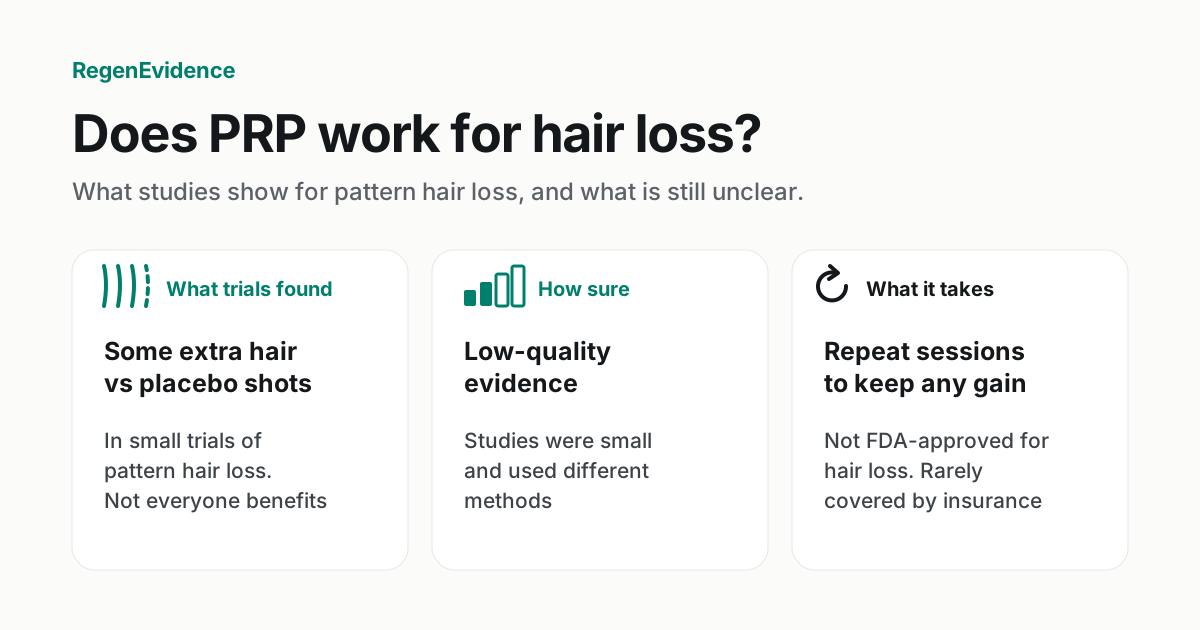
PRP may add some hair for people with pattern hair loss, but the evidence is low quality, results vary, and it must be repeated. Here is what studies show.
The short answer
PRP may help some people with pattern hair loss, but the proof is limited. In research reviews, people who got PRP shots in the scalp ended up with more hairs in a measured patch. They were compared with people who got salt-water shots, used as a placebo.23 But the studies were small and very different from each other, and the overall quality of the evidence is rated low.2
PRP does not help everyone, and some people see no benefit.7 Any gain lasts only while treatment continues.7 In the US, some devices that prepare PRP are FDA-cleared for orthopedic uses, but PRP is not FDA-approved for hair loss, so using it this way is "off-label."67 Proven medicines such as minoxidil, and finasteride for men, are still the usual first choices.19
What is PRP for hair loss?
PRP stands for platelet-rich plasma. A clinician draws a small amount of your blood and spins it in a machine that separates it into parts. The part rich in platelets is then injected into areas where hair is thinning.1
Platelets are tiny pieces of blood cells that help blood clot. They also carry proteins called growth factors, which send signals that help the body repair tissue.7 The hope is that these signals help hair roots, called follicles, grow hair. Exactly how PRP might affect hair is not known.7
There is no single standard recipe. Clinics collect, prepare and inject PRP in many different ways.7 That is one reason results vary from study to study.10
Which types of hair loss has it been studied for?
Most PRP research is on pattern hair loss. Doctors call it androgenetic alopecia. It is the most common type of hair loss, it usually runs in families, and it affects both men and women.29
Other types of hair loss have different causes and different treatments. Sudden shedding after a stressful event usually gets better on its own once the cause is dealt with.9 Patchy hair loss, called alopecia areata, is often treated with steroid shots into the patches or with prescription pills that calm the immune system.9 Hair loss can also come from other health conditions. If a condition such as thyroid disease or lupus is causing it, PRP is unlikely to help, because the condition keeps causing hair loss.89
That is why the first step is finding the cause.1
What does the research show?
A review published in 2024 pooled 13 randomized trials in people with pattern hair loss. Compared with placebo shots, PRP added about 28 hairs per square centimeter of scalp, a patch about 1 centimeter on each side.2 For a sense of scale, people in one trial started with about 151 hairs in each square centimeter.4 PRP did not clearly make each hair thicker.23
The reviewers rated this evidence as low quality. The trials were small and used different methods. There were also signs that studies with good results were more likely to be published.2 Another review of 10 placebo-controlled trials found a similar gain. It saw a larger effect in trials of men alone than in trials of men and women together. It could not judge results beyond 12 months.3 A larger review from 2025 also found more hair with PRP than with placebo. It, too, found wide differences between studies.10
Single trials do not all agree. In a trial of 30 women, experts judged photos without knowing who got which shot. At 24 weeks, 57% of those given PRP had improved, compared with 7% of those given salt water.5 In another trial of 35 people, each person got PRP on one patch of scalp and salt water on another. Hair increased in both patches, and the difference between them was not significant.4 PRP may spread across the scalp in this kind of study, which can hide a real difference.24
How does it compare with standard treatments?
Two medicines have the strongest evidence for pattern hair loss. Minoxidil is applied to the scalp and is the usual first treatment.9 It can help early hair loss, but it cannot regrow a full head of hair. Results usually take 6 to 12 months, and the benefit stops if you stop using it.1 Finasteride is a daily pill approved by the FDA for male pattern hair loss. It tends to help more when started early, and hair loss returns when it is stopped.19
For women, a medicine called spironolactone may be an option. It must not be taken during pregnancy.1 Other choices include laser caps and combs for home use and, for some people, a hair transplant.1
Few studies have compared PRP directly with these medicines, and those studies are small. Reviews do not agree on how PRP compares with minoxidil, so it is not known whether PRP is better, worse or about the same.26
What happens during treatment?
A visit should start with an explanation of the procedure and a consent form to sign.7 Then your blood is drawn and prepared. The PRP is injected into many small spots on the thinning areas, sometimes more than 100 in one session.17 The scalp is often numbed first.8 Some clinics also use microneedling, which makes tiny pricks in the skin.7
The procedure itself may take about 10 minutes, though a full visit can take longer. Most people do not need time off afterward.18 Before your visit, you may be asked not to use hair products that day and to pause some pain relievers or supplements.8 If you take a blood thinner, talk with the doctor who prescribed it before changing anything.
PRP is given as a series. A common plan is one session a month for 3 months, then one every 3 to 6 months, but there is no standard schedule.17 Some people notice less shedding in the first few months. Visible growth can take up to six months.17 If you stop treatment, the hair you gained is likely to be lost over time.7
What are the side effects and risks?
Side effects in studies were mostly mild and short-lived. The most common was brief pain where the needle went in.2 People have also reported headache, a tight feeling in the scalp, swelling, redness and some bleeding at the injection sites.5 Itching and a short period of extra shedding can happen too.8
Serious problems appear to be rare.26 Because PRP comes from your own blood, you cannot catch an infection from a donor. But the skin of the scalp cannot be made fully germ-free, so clean technique matters.7 Most trials followed people for a year or less, so less is known about the long-term effects of many repeated sessions.3
Who might be a good candidate?
PRP is most likely to help people whose hair is thinning, not fully bald, and whose hair loss is fairly recent.78 Hair loss that has gone on for a long time may respond less.8 Areas that are completely bald are not likely to benefit.7
PRP may not be right if you have an active skin problem on the scalp, such as skin cancer or a pre-cancer, or certain other health conditions.7 Blood thinners may make PRP less effective.8 A dermatologist, a doctor who treats skin and hair, can help find the cause of your hair loss and talk through your options.1
What about cost and insurance?
In the US, insurance usually does not pay for PRP for hair loss, because it is treated as a cosmetic procedure.8 PRP has to be repeated to keep any benefit, so the total cost depends on how many sessions you have over time.7
Before you start, ask for the full plan in writing. This should include the first series, the follow-up sessions, and how progress will be checked.78
Questions to ask before you decide
What type of hair loss do I have, and what is causing it?1
Have I tried, or could I use, minoxidil or other proven treatments first?19
What have studies shown for people with my type of hair loss?23
How will we measure whether it is helping, such as with photos or hair counts?2
How is your PRP prepared, and how many sessions will I need, including later sessions?7
What side effects should I expect, and who do I call if I have a problem?7
What will the full course cost over a year, and will insurance pay any of it?8
What happens if I stop?7
The bottom line
PRP may add some hair for people with pattern hair loss, but the evidence is low quality and results vary. It is not FDA-approved for hair loss, it must be repeated, and it is rarely covered by insurance.2678 Proven medicines are still the usual place to start.19
Talk with a doctor who knows your health history before trying any hair loss treatment. This article is for general education. It is not medical advice.1
Sources · 10
- 1Source 1(opens in a new tab)
Patient page · 2022
- 2Source 2(opens in a new tab)
Research review · 2024
- 3Source 3(opens in a new tab)
Research review · 2023
- 4Source 4(opens in a new tab)
Trial summary · 2020
- 5Source 5(opens in a new tab)
Trial summary · 2020
- 6Source 6(opens in a new tab)
Evidence summary · 2022
- 7Source 7(opens in a new tab)
Patient page
- 8Source 8(opens in a new tab)
Patient page
- 9Source 9(opens in a new tab)
Clinical review · 2024
- 10Source 10(opens in a new tab)
Research review · 2025
Ask a question in your own words. A question stays on the ask page. It is not added to this article or to a share link.
For learning only. Not medical advice. Talk to your doctor.