Do PRP injections work for knee arthritis?
Published .
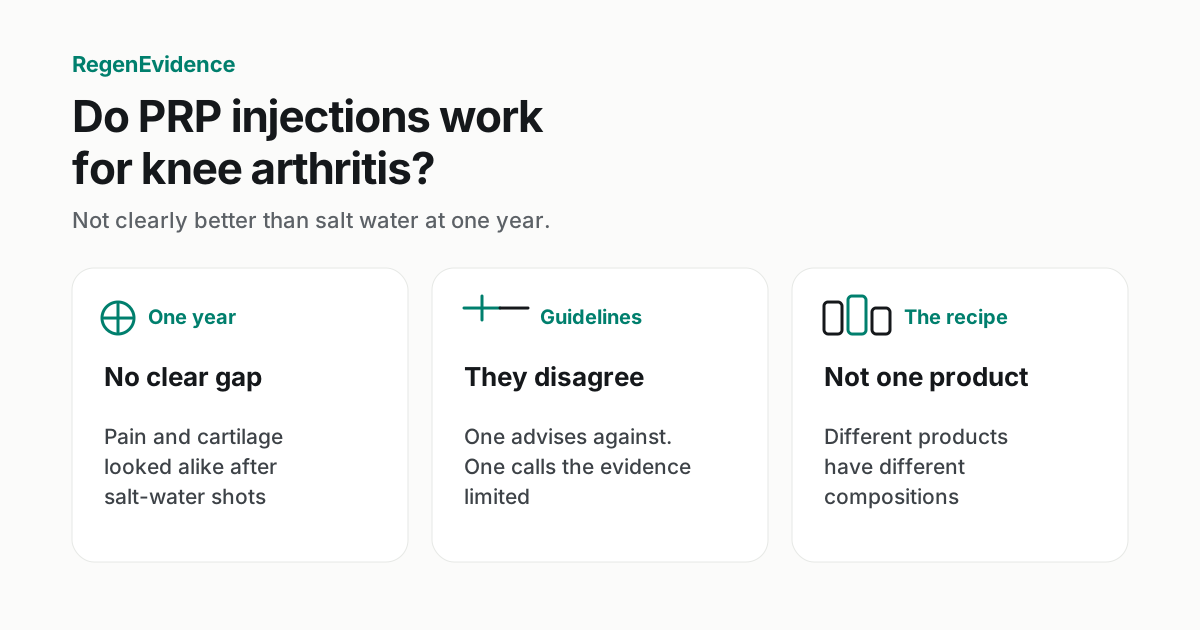
Not clearly. A 288-person salt-water trial found no clear difference in pain or cartilage at one year. Guidelines disagree.
The short answer
Not clearly. Platelet-rich plasma, or PRP, is a shot made from your own blood. Knee osteoarthritis is the common kind of knee arthritis: the cartilage in the knee joint gradually wears away. In the studies below, a placebo is a comparison shot, such as salt water, that does not contain PRP.414
In a 288-person trial, three PRP shots were not clearly better than three salt-water shots at one year. Pain fell in both groups. Cartilage on the inner side of the knee thinned by about the same amount. A 2026 update from a major US arthritis group strongly recommends against PRP for knee and hip arthritis. A 2021 orthopaedic guideline says PRP may reduce pain and improve function, but it rates that evidence as limited. Its last literature search was in April 2020, before the large trial was published. Smaller trials, and reviews that pool many trials, sometimes report a benefit. Those reports do not line up with each other, or with the large trial.4561011
What knee osteoarthritis is
Osteoarthritis is the most common form of arthritis in the knee. In osteoarthritis, the cartilage in the knee joint gradually wears away.14
Most care aims to ease pain and help you move. Exercise, weight loss when it applies, and medicines are the usual starting points. A doctor may recommend surgery if arthritis pain causes disability and is not relieved with nonsurgical treatment. A PRP shot does not replace finding out which kind of knee pain you have.1114
What a PRP shot is
Plasma is the liquid part of blood. Platelets are a type of blood cell that plays an important role in healing. PRP is a portion of your blood with more platelets than the sample you started with. A clinician draws blood, spins it in a machine called a centrifuge, and injects the platelet-rich portion into the knee. Ultrasound is sometimes used to guide the needle.12
There is no single recipe. Different PRP products have different compositions. One patient page describes two broad kinds. Leukocyte-rich PRP has more white blood cells than the original blood sample. Leukocyte-poor PRP has fewer. Studies have not settled which recipe, if any, is better for a knee.237
An FDA 510(k) summary for one device that prepares PRP says the plasma from that device has not been evaluated for any clinical use. The use listed for it is mixing the plasma with bone graft so the graft is easier to handle during surgery. That is not an approval to treat knee arthritis. A decision that a device can prepare the plasma is not proof that a shot into the knee helps.13
PRP is used more and more for knee arthritis, but the authors of the large trial said evidence of a clinical benefit is limited.4
What a large blinded trial found
A 2021 trial enrolled 288 adults aged 50 or older with pain on the inner side of the knee and mild to moderate changes on X-ray. The average age was about 62, and about 59 percent were women. People were assigned by chance to three weekly shots of leukocyte-poor PRP or three weekly shots of salt water. Neither the person nor the clinician giving the shot knew which fluid was in the syringe, and a check of that blinding held. In each group, 140 of 144 people received all three shots. About 93 percent were still in the trial at one year.4
The PRP in that trial came from a commercially available product. It had about 1.6 to 5 times as many platelets as whole blood, and it was leukocyte-poor. That is one recipe, not every product a clinic may use.4
At one year, average knee pain, scored from 0 to 10, fell by 2.1 points with PRP and by 1.8 points with salt water. The gap was 0.4 points. The range of likely gaps ran from 0.9 points in favor of PRP to 0.2 points in favor of salt water. The study treated 1.8 points as a meaningful change for one person. Both groups, on average, changed by about that much. The gap between the groups was smaller, and the likely range did not include a gap that large. Cartilage volume on the inner shinbone fell by 1.4 percent with PRP and 1.2 percent with salt water. The gap was 0.2 percent, with a likely range from 1.9 percent more loss with PRP to 1.5 percent less loss. Of 31 other planned results, 29 were not clearly different.4
Two of those other results did differ, and they point in different directions. At two months, about 48 percent of the PRP group and about 36 percent of the salt-water group said they were improved overall. At one year, about 43 percent and about 32 percent said their function was improved, a borderline difference. At the same time, more people in the PRP group had thinning in three or more cartilage areas: about 17 percent, compared with about 7 percent. The authors' conclusion was that these findings do not support using PRP for knee arthritis. Feeling better during the year, including after salt water, is not the same as PRP doing more than the placebo.4
Where other studies disagree
A 2024 trial assigned 30 adults with mild to moderate knee arthritis, who also had extra joint fluid or bone changes on MRI, to leukocyte-poor PRP shots or salt-water shots. At 24 weeks, the middle improvement on a knee score was about 76 percent with PRP and about 28 percent with salt water. About 73 percent of the PRP group and about 29 percent of the salt-water group had their pain score improve by half or more. The person giving the shot knew which fluid it was. The person receiving it, and the clinician scoring the visits, did not. The authors called the 24-week follow-up a main limit. Thirty people, a selected group, and half a year of follow-up cannot overturn a 288-person trial that followed people for a year. They do show why one small study can look favorable.5
Reviews that pool many trials often report a benefit, and they often disagree with the large trial. A 2025 overview searched through December 1, 2024, and found 29 such reviews. It rated 26 of them as critically low in quality and 3 as low. The same studies were reused across reviews. The overview said positive reports are common, the findings are inconsistent, and a firm conclusion cannot be drawn.6
A 2026 review of placebo comparisons searched through May 25, 2025. Its summary says 20 trials, with 1,774 people in PRP groups and 1,518 in placebo groups, showed better pain and function at 6 months and at 12 months. It calls that a large effect with very low certainty. It also says younger age, a bigger rise in platelets, leukocyte-rich PRP, and one way of activating the platelets lined up with better 6-month scores. Those features were tangled together, and none of them explained the 12-month results. The authors called that recipe analysis an idea to test, not proof of a best formula. The authors report no conflicts in that summary.7
A separate 2026 review of 62 trials, searched on March 25, 2025, found that the trials disagreed with one another a great deal. Only two trials reported one-year results against salt water, too few to pool. Several of the review's authors work for, or hold leadership roles in, a company that provides PRP for knee osteoarthritis, and one is an inventor on issued patents or patent applications. A pooled average from uneven trials is not the same as the result of a large blinded trial.48
Gel shots and steroid shots
Hyaluronic acid, often called a gel shot, is injected into the knee. The 2026 arthritis update conditionally recommends against these shots for knee arthritis. The 2021 orthopaedic guideline says they are not recommended for routine use. A steroid shot is different. The 2026 update strongly recommends a steroid shot for knee and hip arthritis. The 2021 orthopaedic guideline says a steroid shot could provide short-term relief. The relief does not last indefinitely.101114
The 2021 orthopaedic guideline, using studies gathered through April 2020, found PRP and gel shots about the same at six months. In a pooled analysis of four trials, PRP did better than gel shots at 9 to 12 months, but more trials found extra side effects with PRP. The guideline still rated its PRP statement limited. Those comparisons come from trials that used different recipes and different patients.11
A pooled average from uneven trials does not show that PRP beats a salt-water shot in a large blinded trial. The gel shot itself is not strongly supported.811
What guidelines say
A 2019 US arthritis guideline strongly recommends against PRP for knee and hip arthritis. The reason it gives is that preparations and techniques are not standardized, so it is hard to know what is being injected.9
The 2026 update of that guideline, in a summary the group's board approved on September 8, 2026, still strongly recommends against PRP for knee and hip arthritis. The full paper was not yet published when this page was written, so the detailed reasons for the 2026 vote are not in the summary. The same summary strongly recommends exercise and, for people with overweight or obesity, weight loss. It strongly recommends a topical anti-inflammatory medicine for the knee and an oral anti-inflammatory medicine. It strongly recommends a steroid shot into the knee. It conditionally recommends a knee brace. It conditionally recommends against gel shots. It says clinicians should refer people to physical therapy.10
A 2019 international osteoarthritis guideline also strongly recommends against PRP shots. It cites extremely low-quality evidence and formulations that are not standardized. That guideline was finished before the large 2021 trial.12
The 2021 orthopaedic guideline is the main disagreement. It says PRP may reduce pain and improve function, and it rates the evidence limited. The group downgraded that statement because results were mixed and differed between early and late stage arthritis. It also said a study's report of treatment-related side effects raises safety questions that need more study. Its primary search was March 1, 2019, and its secondary search was April 28, 2020. It does not include the large salt-water trial published in 2021. The same guideline strongly recommends exercise over no exercise. It recommends topical and oral anti-inflammatory medicine when they are a reasonable choice for you. It recommends sustained weight loss for people with overweight or obesity, at moderate strength.11
What happens at the visit
The steps are usually the same, even when the recipe is not. Blood is drawn from a vein. The sample is spun so the platelet-rich portion can be taken off. That portion is injected into the knee. The visit for a joint can take about an hour, including the preparation, not only the shot. A clinician may use ultrasound. In the large trial, the knee was bent and straightened five times after the shot, and people rested for 10 minutes.124
Ask how many shots are planned, how far apart they are, whether the needle is guided, and what is in the syringe: how many platelets, and whether white blood cells are kept in or taken out. A plan for a series does not, by itself, show that more shots will help more.24
A clinician may ask you to pause a blood thinner or an anti-inflammatory medicine before the shot. Do not stop a prescribed medicine on your own. Ask what to do about food, drink, and your own medicines.2
Recovery and risks
Soreness and bruising at the injection site can follow the shot. In the large trial, knee pain, swelling, and stiffness after the shots were reported more often after PRP than after salt water. The events in that trial were described as minor and short-lived, and the authors reported no serious event related to the shots. In the trials on this page, results were checked at 4 weeks or later, not on the day of the shot.145
Using your own blood does not remove the risks of a needle. Less common risks listed on a hospital page include bleeding, tissue damage, infection, and nerve injury. There is no single complication rate that fits every recipe and every knee.1
The 2021 orthopaedic guideline noted a study that reported high blood pressure and protein in the urine as treatment-related side effects. The guideline said this raises safety questions that need more study. It is not a rate for every shot.11
A joint infection needs urgent care. Warning signs include sudden severe pain in a joint, trouble moving the joint or putting weight on it, and skin over the joint that is hot, swollen, or red. Redness can be harder to see on black or brown skin. A fever can come with it, but not everyone has one. These signs are general guidance for a joint infection. They are not a PRP aftercare sheet.15
Who was studied
The large trial enrolled adults 50 and older with mild to moderate knee osteoarthritis on X-ray, on the inner side of the knee, who had symptoms. The small 2024 trial enrolled people with mild to moderate knee arthritis who also had extra joint fluid or bone changes on MRI. Matching a study's volunteers is not a reason to have the procedure. It is a reason to ask whether you are even in the group that was studied.45
Some blood conditions make PRP a poor fit, and results vary from person to person. A clinician who knows your knee, your medicines, and your other health problems has to make that judgment. This page cannot.2
What else has support
Guidelines put other care ahead of PRP. Support is strongest for exercise, including a referral to physical therapy, and for weight loss when you have overweight or obesity. Topical and oral anti-inflammatory medicines are strongly recommended when they are a reasonable choice for you. Oral anti-inflammatory medicines need extra care, or should be avoided, if you have heart disease, heart failure, or chronic kidney disease. A steroid shot can give short-term relief. A brace or a cane can help some people. Gel shots are not recommended for routine use.101114
Surgery may be recommended if arthritis pain causes disability and is not relieved with nonsurgical treatment. It is a bigger step, and it is not the next automatic choice after one injection. Stem cell shots are a different treatment. They are not PRP, and they are not reviewed on this page.14
Cost and insurance
This page does not list a price. There is not one charge that fits every offer. Few insurance plans, including workers' compensation plans, pay even part of a PRP shot. A hospital page ties that gap to the lack of an FDA approval for the use. Ask your plan, for this diagnosis and this procedure, before you agree. Ask what the bill includes: the visit, the blood draw, the spinning, the shot, any imaging, later visits, and a second or third shot.13
Questions to ask
What is causing my knee pain, and is it osteoarthritis on the X-ray, or something else?14
How many shots are you suggesting, what is in each one, and how does that recipe compare with the one in the large salt-water trial?4
What did that trial show at one year for pain and for cartilage, and what did smaller studies show that it did not?45
Which guideline are you following, and what does it say about PRP, exercise, a steroid shot, and a gel shot?1011
What should I expect in the first few days, and which symptoms need urgent care?415
Will insurance pay any of this, and what do I pay if it does not?3
If the shot does not help, what is the next step, and what would I be putting off?1114
The bottom line
PRP shots have not been shown to help knee arthritis more than a salt-water shot in a large blinded trial of 288 adults. Pain can fall after either one. Cartilage loss was about the same with PRP and salt water. Guidelines mostly advise against PRP for this use, one orthopaedic guideline is more open but calls the evidence limited, and pooled reviews that report a benefit are uncertain and often low in quality. The shot is made from your blood, and the recipe is not standard. Ask how the evidence applies to your knee, and what has stronger support, before you decide.461011
This page is for learning. It is not personal medical advice.
Sources · 15
- 1Source 1(opens in a new tab)
Patient page
- 2Source 2(opens in a new tab)
Patient page · 2024
- 3Source 3(opens in a new tab)
Patient page
- 4Source 4(opens in a new tab)
Trial report · 2021
- 5Source 5(opens in a new tab)
Trial report · 2024
- 6Source 6(opens in a new tab)
Review page · 2025
- 7Source 7(opens in a new tab)
Review summary · 2026
- 8Source 8(opens in a new tab)
Review page · 2026
- 9Source 9(opens in a new tab)
Clinical guideline · 2020
- 10Source 10(opens in a new tab)
Guideline summary · 2026
- 11Source 11(opens in a new tab)
Clinical guideline · 2021
- 12Source 12(opens in a new tab)
Clinical guideline · 2019
- 13Source 13(opens in a new tab)
Regulator page · 2024
- 14Source 14(opens in a new tab)
Patient page
- 15Source 15(opens in a new tab)
Patient page · 2026
Ask a question in your own words. A question stays on the ask page. It is not added to this article or to a share link.
For learning only. Not medical advice. Talk to your doctor.