Does stem cell therapy work for autism?
Published .
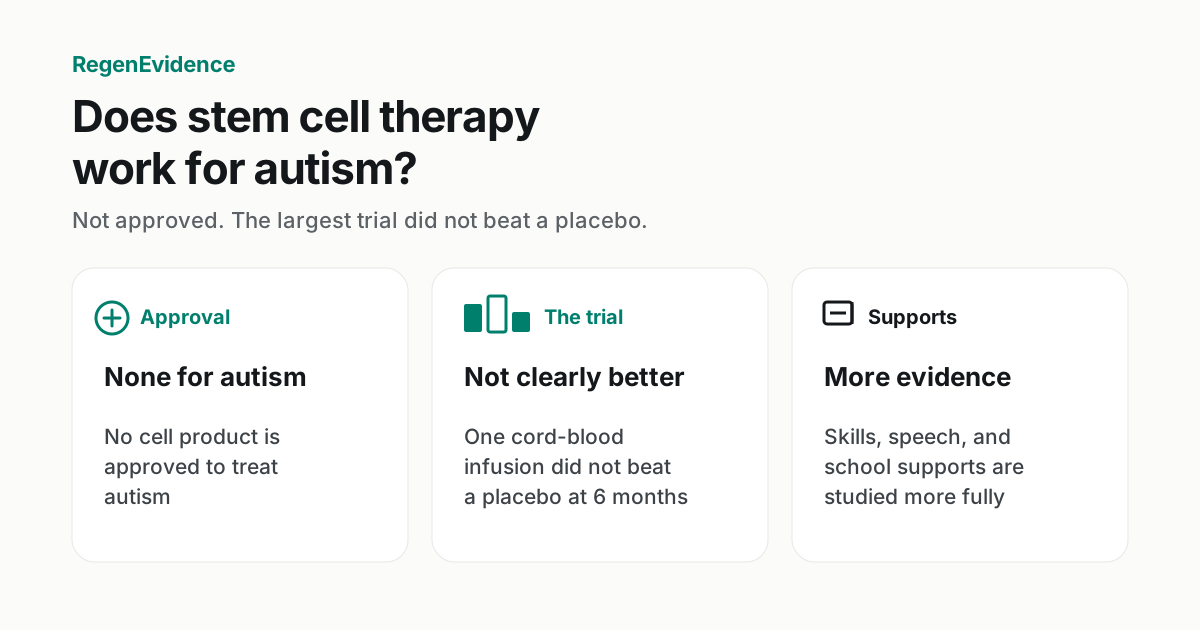
Not clearly. No cell product is approved for autism. The largest comparison of one cord-blood infusion did not beat a placebo at 6 months.
The short answer
Not clearly. The FDA says regenerative medicine therapies have not been approved to treat autism. Autism is a neurological and developmental condition. No cell product has been shown to change its core features.123
In the largest comparison, 180 children ages 2 to 7 received one infusion of umbilical cord blood, or a placebo, into a vein. A placebo is an inactive comparison fluid. At 6 months, cord blood was not tied to better social communication, fewer autism symptoms, or a larger vocabulary.5
A later comparison of cells grown from umbilical cord tissue also did not show a clear difference on its main social and communication score. A 2022 review of five earlier studies reported a lower score on one rating scale, and its authors said those studies were too small, too different, and too short to settle the question. A 2026 study of 34 children reported a modest difference on one parent questionnaire after 13 weeks. That does not replace the larger comparisons. Being offered an infusion is not the same as a comparison showing a benefit.8910
What autism means here
Autism changes how a person communicates, learns, spends time with other people, and behaves. Signs often appear in the first two years of life, and a person can be identified at any age. The clinical name is autism spectrum disorder. Autistic people differ widely. Some need substantial daily support. Some need little. Some also have an intellectual disability, seizures, anxiety, sleep problems, or stomach problems. Those are separate issues.23
Supports aim to ease symptoms that get in the way of daily life, and to build skills. Behavioral approaches have the most evidence for those interfering symptoms. No medicine treats the core features of autism. Some medicines help problems that occur alongside it, such as very high energy, trouble focusing, self-injury, anxiety, seizures, or sleep problems. A medicine decision belongs with a clinician who knows that person.2
What is being offered
Stem cell therapy is not one procedure. The material, the dose, and where it is put in the body all change what a study can say.18
Umbilical cord blood is blood left in the cord and placenta after birth. A study may use the child's own banked unit or a donor unit. Umbilical cord tissue is a different source. Cells called mesenchymal stromal cells can be grown in a lab from that tissue. Other studies use cells from bone marrow or from fat. Some infusions go into a vein. Some go into the fluid around the spinal cord. A finding for one of these does not apply to the others.6810
A stem cell research society's patient pages separate three situations. A few uses of blood-forming stem cells are accepted care for diseases of the blood. Investigational treatments are tested in trials with regulatory oversight. Unproven treatments are sold without that process. The society says stem cell treatments for most other conditions have not been shown to be safe and effective. The FDA says products made from stem cells, fat, or cord blood generally need approval before they are sold, and need oversight in a trial before that approval. None are approved to treat autism. Cord-blood products that page describes as approved are for disorders that affect the making of blood, not for autism. A page on a trial registry, or a firm's registration with the FDA, does not mean a product is legally marketed.11114
Some studies start from a theory that immune activity in the brain could be part of autism for some children, and that certain cells might calm that activity. That is a reason to run a trial. It is not evidence that an infusion helps. Cells from a person's own body are not automatically safe once they are taken out and put back.711
The largest cord-blood comparison
A 2020 trial assigned 180 children with autism, ages 2 to 7, by chance. Fifty-six received their own cord blood, 63 received donor cord blood, and 61 received a placebo. Each child got one infusion in a vein. Families and the people scoring the visits were not told which fluid it was. At 6 months, the whole group showed no evidence that cord blood improved social communication, autism symptoms, or vocabulary. Own cord blood and donor cord blood did not clearly differ from each other. The authors' overall conclusion was that one infusion was not tied to better socialization or fewer autism symptoms.5
The authors also looked at children who did not have an intellectual disability. In that smaller group, donor cord blood, not the child's own, lined up with a larger share of children a clinician rated as improved, but the odds of that rating were not clearly higher. Communication scores, and some measures of attention and brain waves, did change in children without an intellectual disability who received cord blood. Those are extra looks. They are not the result the trial was built to answer, and they are not proof that the infusion helps some children.5
A clinic that offers a series of infusions, a spinal injection, or cells from fat, bone marrow, or cord tissue is not offering the single cord-blood infusion this trial tested.58
Smaller cord-blood studies
An earlier study gave one infusion of the child's own cord blood to 25 children and followed them for 12 months. The middle age was about 4.6 years. It was an open-label study, so everyone knew the child received cells. The authors reported changes on parent and clinician measures, and no serious adverse events. A study without a comparison group cannot show that the infusion caused the change. Children also develop over a year, and a family that expects a benefit may score behavior differently. One author directs cord-blood banks.67
A crossover trial enrolled 29 children ages 2 to 6 who already had their own cord blood banked. Each child received cord blood and, at another time, a placebo, in random order. The main measures were single-word vocabulary tests. There were no serious adverse events. Scores leaned toward improvement, especially for socialization, but no endpoint was clearly different. A socialization score that looked different at 12 weeks was not clearly different after a correction for looking at many scores. The authors said there was minimal evidence of a clinical effect. The study was funded by a cord-blood bank company, and the lead author received fees from that company.6
Cord tissue, and a later trial
Cord tissue is not a bag of cord blood. A completed trial enrolled children ages 4 to 11. They received either cells grown from donor cord tissue, about 6 million cells for each kilogram of body weight, or a placebo, in a vein. Sixty-eight children were assigned to the cell group and 69 to the placebo group. The main score averaged the socialization and communication parts of the Vineland scale at 6 months, before a second infusion, and was analyzed in 66 and 69 children. The cell group rose by about 3.4 points and the placebo group by about 2.0. The gap was about 1.3 points. The likely range ran from about 0.9 points in favor of placebo to about 3.5 points in favor of the cells. That is not a clear difference. On this scale, 100 is a typical score for a child's age and about 15 points is a usual spread, so a gap near 1 point is small. The communication score alone was almost the same in the two groups. These figures were posted on the trial's public registry record on June 24, 2026. The record lists no journal paper reporting them.9
A 2026 trial enrolled children ages 3 to 8 who had autism and at least one immune-signal blood test more than 1.5 times the lab's usual upper limit. Thirty-six children were randomized. Thirty-four were analyzed, 17 in each group. Each child received four weekly infusions in a vein, of donor cord-blood cells or a placebo, and kept the rehabilitation already in place. Follow-up lasted 13 weeks. The trial's main measure, a parent-rated social responsiveness score, fell more with the cells, by about 6 points. The likely range ran from about 12 points down to just above zero. One part of that score, social cognition, differed by more. Everyday communication, daily living, and socialization on another scale did not clearly differ. The authors call the study small, the follow-up short, and the scores subjective. A selected group and a short follow-up do not replace the larger trials. The 2022 review searched only through July 24, 2021, so it includes neither this trial nor the cord-tissue comparison.810
What a pooled review can say
The 2022 review pooled five studies in children. Together they used cord blood, bone marrow cells, or cord cells. Some gave the cells in a vein. Some used a needle into the spinal fluid. The comparison was often rehabilitation, not a placebo infusion. On the Childhood Autism Rating Scale, the cell groups scored about 6 points lower than the comparison groups. On a clinician's global judgment, about 62 percent of the cell groups and about 60 percent of the comparison groups were counted as improved. That is not a clear difference. Adverse events were not clearly more common with the cells.8
The authors said the evidence is weakened by small studies, doses and routes that are not standard, and short follow-up. A pooled average from unlike studies is not the same thing as a large placebo trial. The lower rating-scale score should not be read as proof that cell therapy helps.8
What the procedure involves
The steps depend on the product. For cord blood, a stored unit is thawed and given through a vein. In the 29-child crossover study, the infusion took about 5 to 15 minutes. Staff checked vital signs until it was finished and for about an hour afterward. Children went home if they had no sign of an allergic reaction and their vital signs were stable, and they came back the next day.6
In the 25-child study, the infusion was also a single dose in a vein. A few children had an allergic reaction the same day, such as a rash or a cough. There were no serious adverse events in that study. Cells grown from cord tissue are made from donor tissue rather than from a unit saved at the child's birth. Collecting bone marrow or fat is a separate procedure. A paper discussing those sources calls the collection invasive.710
Some studies inject cells into the spinal fluid instead of a vein. The 2026 trial used a vein and, in explaining that choice, said spinal injections have included headache, nausea, vomiting, and pain where the needle went in. Ask what is in the bag, whose cells they are, whether they were grown in a lab, how many infusions are planned, and whether any needle enters the spine.1011
Risks, including infections
A needle and a cell product can cause harm. That includes products made from cord blood and products made from a person's own cells.11
In the studies on this page, serious events were uncommon. That is not a safety record for every product a clinic prepares. The 25-child study recorded no serious adverse events. Twelve of 92 events in that study were judged related to the infusion, most often an allergic reaction the same day. The 29-child study reported no serious adverse events. The cord-tissue registry's adverse event table lists an infusion related reaction in 13 of 68 children after the first cell infusion and in 2 of 69 after the first placebo infusion. A separate safety count on the same record lists 14 of 68 and 2 of 69. It lists no deaths. In the 2026 trial, four children in the cell group had brief excitement and one had a brief low fever. In the placebo group, two children had brief excitement, three had a brief low fever, and one had mild leakage of fluid at the infusion site. The authors reported no major transplant-related adverse event. Feeling well in one study is not a reason to skip the question of infection, a bad reaction, or a product that was never tested for that use.67910
The FDA has received reports of serious harm from unapproved regenerative products. The reports include life-threatening blood infections, unwanted immune reactions, tumors, blindness, and cells that grow into an unintended tissue. Those reports are not one risk number for an autism infusion. They show that serious harm has happened.1
In 2018, US health departments reported bacterial infections in 12 people who received umbilical cord blood products for uses other than rebuilding blood or the immune system. All 12 were hospitalized. None died. Infections included bloodstream infections, joint infections, and abscesses beside the spine. For the 11 people whose reason was known, the reason was pain or a joint problem, not autism. Bacteria grew from unopened vials. The report says products like these are still marketed for neurologic conditions without FDA approval, and that outpatient settings often have weaker checks on infection control. Cord blood cannot be sterilized after it is collected.13
Travel does not remove those risks. Patient guidance from a stem cell research society says an unproven treatment can create new health problems, can make a person ineligible for a later trial, and is often not covered by insurance. Travel also means time away from the people who usually help. A trip to a clinic is not the same thing as a regulated trial.11
Supports with more evidence
Behavioral approaches have the most evidence for autism symptoms that interfere with daily life. One widely used form is applied behavior analysis. It teaches skills in small steps and tracks progress. It is not the only support, and it is not a fit for every person. Speech and language therapy is the most common developmental therapy. Some people speak. Others use signs, pictures, or a communication device. Occupational therapy teaches everyday skills such as dressing, eating, and bathing. There is no single program that fits everyone. Most people do best with a program that is structured and matched to them. Support that starts early, including before school age, is more likely to have a large effect on later skills. Support at any age can still help.2412
In the United States, a parent can ask for an early-intervention evaluation for a child under 3 without a doctor's referral. Public programs can be free or cost less for a child who is eligible. From age 3, the local public school can evaluate a child, including a child who is not yet in kindergarten. Many autistic students have an individualized education program or a 504 plan. These services are not cell infusions. A cell product does not replace them. Talk with a clinician who knows the person before starting a complementary product.212
Trials are not a service you pay for
The large cord-blood trial enrolled children ages 2 to 7. The crossover trial enrolled children ages 2 to 6 who already had banked cord blood. The cord-tissue trial enrolled children ages 4 to 11. The 2026 trial enrolled children ages 3 to 8 with an immune-signal blood test more than 1.5 times the lab's usual upper limit. Autistic adults were not the groups in these trials. A person outside those groups was not the person studied. Matching a study's volunteers is not a reason to buy an infusion. It is a reason to ask whether a registered study is even open.56910
A stem cell research society's patient guidance describes a responsible trial in a few plain features. An independent ethics group reviews it. It is listed in a recognized registry. It usually compares the new treatment with a group that does not receive it. It does not charge the participant for the new treatment and monitoring. The FDA says that if you are charged for these products outside a clinical trial, you are likely being offered a product illegally. A registry listing by itself does not make a paid service into a trial, and it does not mean the product is approved. Ask to read the consent form before anyone pays. Go through it with a clinician who is not selling the product.111
Cost and insurance
This page does not list a price. There is not one charge that fits every offer. In most cases, insurance and government health programs do not cover an experimental treatment. What a family pays can be large, and travel adds time away. Early-intervention and school services are a different kind of support. Eligible children can receive them for free or at a lower cost through public programs. Ask the plan what it will pay for a cell product. If the offer is a trial, ask which costs the study pays and which it does not, before you agree.1112
Questions to ask
What is in the infusion: the child's own cord blood, donor cord blood, cells grown from cord tissue, fat, or bone marrow? Were the cells grown in a lab? Does the needle go into a vein or into the spine?810
Is any cell product approved for autism? If this is a study, who reviews it, where is it listed, and can we read the consent form before we pay?111
What did comparison studies show for this exact preparation, including the 180-child cord-blood trial, and how long were children followed?59
What reactions and infections have been reported, and who cares for my child if one happens after we go home?713
What speech, school, behavioral, or medical supports fit this person, and what would we put off by doing this instead?212
Will insurance pay any of this? If it is a trial, which costs does the study pay?11
The bottom line
Cell infusions have not been shown to help autistic children or adults in a reliable way. No regenerative medicine product is approved by the FDA to treat autism. The largest placebo comparison of one cord-blood infusion did not improve social communication, autism symptoms, or vocabulary at 6 months. A later cord-tissue comparison did not show a clear difference on its main score. Smaller or shorter studies sometimes report a change on a questionnaire. They do not replace those comparisons, and they do not describe every product a clinic may sell. Behavioral, communication, and school supports have more evidence.1259
This page is for learning. It is not personal medical advice.
Sources · 14
- 1Source 1(opens in a new tab)
Regulator page · 2021
- 2Source 2(opens in a new tab)
Patient page
- 3Source 3(opens in a new tab)
Patient page · 2024
- 4Source 4(opens in a new tab)
Patient page
- 5Source 5(opens in a new tab)
Trial report · 2020
- 6Source 6(opens in a new tab)
Trial report · 2018
- 7Source 7(opens in a new tab)
Trial report · 2017
- 8Source 8(opens in a new tab)
Pooled review · 2022
- 9Source 9(opens in a new tab)
Registry record · 2026
- 10Source 10(opens in a new tab)
Trial report · 2026
- 11Source 11(opens in a new tab)
Patient guidance
- 12Source 12(opens in a new tab)
Patient page · 2026
- 13Source 13(opens in a new tab)
Outbreak note · 2018
- 14Source 14(opens in a new tab)
Patient guidance
Ask a question in your own words. A question stays on the ask page. It is not added to this article or to a share link.
For learning only. Not medical advice. Talk to your doctor.