Does stem cell therapy work for back pain?
Published .
Not clearly. No stem cell product is FDA-approved for back pain. The largest comparison trials of disc injections did not meet their main goals.
The short answer
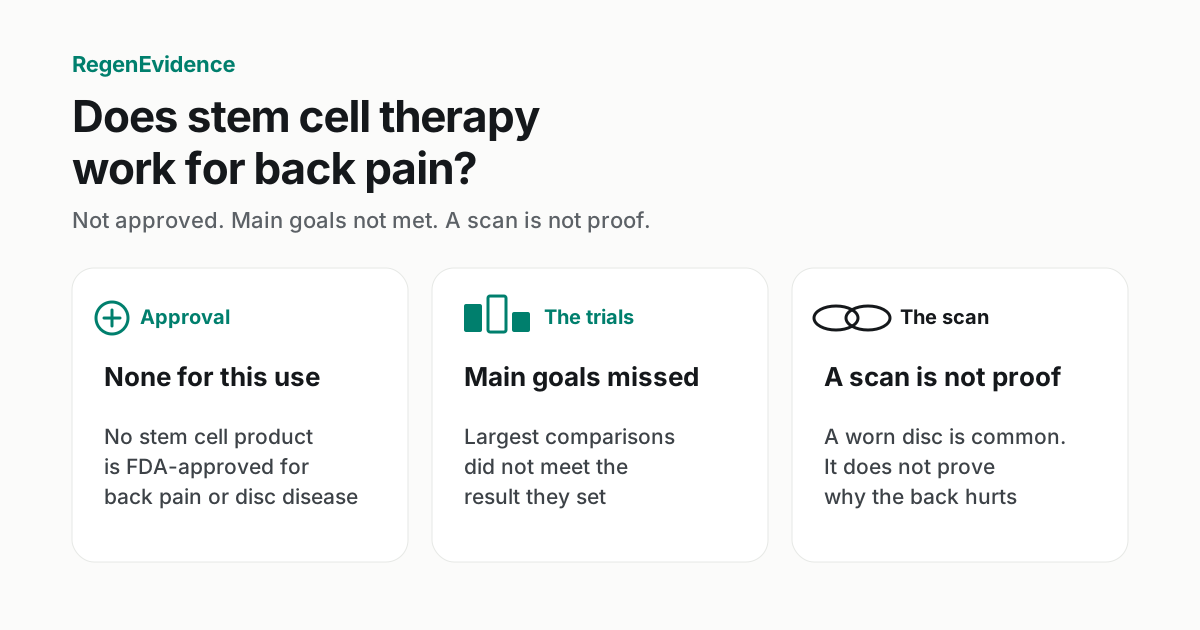
Not clearly. No stem cell product is approved by the FDA for back pain or for disc disease. In the largest comparison trials, lab-grown donor cells injected into one worn disc did not meet the study's main goal. One trial reported a lower average pain score for one preparation, but that finding is narrower than the main result. It does not apply to every product a clinic may offer.1234
A worn disc on a scan is common, and it does not by itself prove the disc is causing the pain. Most of this research is about pain thought to come from a single worn disc. It is not a test of back pain in general.5
What kind of back pain is this?
Low back pain has many causes. A muscle strain, a joint problem, a pinched nerve, and a worn disc can feel alike. A 2017 primary care guideline says most people with newer back pain, lasting less than 12 weeks, improve over time no matter which treatment they use.6
Pain thought to come from a damaged disc is called discogenic pain. The disc is the cushion between the bones of the spine. Degenerative disc disease is a name for wear in that cushion. Wear on a scan is common in people with no pain. A review of these studies says a worn disc and back pain do not match in a reliable way.5
The 114-person trial enrolled adults whose doctors thought one disc was the source, and it left out pain that seemed to come mainly from the facet joints, the small joints at the back of the spine. The ongoing trial also leaves out facet-joint pain and pain from the sacroiliac joint, where the spine meets the pelvis.37
What are clinics offering?
Stem cell therapy is not one procedure. Clinics use different materials, and a result for one does not carry over to another.29
Some draw bone marrow from the pelvis, spin it, and inject the concentrate the same day. Some take fat from the belly or thigh and inject cells from that. Some use cells grown in a lab from a donor. Some offer material from birth tissue, such as umbilical cord or amniotic fluid. Platelet-rich plasma, often called PRP, is a different injection made from blood, not from stem cells.89
A bone marrow or fat sample is mostly other cells. One specialty center explains that true stem cells are only about 1 in 10,000 of the cells in these tissues.8
In the United States, the FDA says stem cell products generally need approval before they are sold to treat a disease. That includes products made from your own body. None of these products are approved for disc disease or back pain. A narrow exception can apply when your own tissue is removed and put back into you during the same surgical procedure. That exception is not an approval, and it does not show that a procedure works. A listing in a trial registry does not mean a product is approved.1210
What the largest trials found
A 2024 trial assigned 114 adults by chance to one injection of 20 million donor bone marrow cells into a single disc, or to salt water placed under the skin. The comparison shot did not go into the disc. People were ages 18 to 60, with pain for at least 3 months, and they had not had spine surgery. At one year, about 74 percent of the cell group and about 69 percent of the comparison group met the study's bar for improvement. The study did not show a difference between those rates. Pain scores, function scores, and the fluid signal of the disc on MRI (a detailed picture made with a magnet) also did not clearly differ. The authors said they did not show a benefit for symptoms or for the disc image. People in both groups had less pain than when they started.3
The paper's opening summary says no serious event was related to the injection. The detailed results are less tidy. Some people, in both groups, had a serious but temporary worsening of low back pain that the investigators tied to the injection or the study product. No one left the study because of a serious event. The authors reported no disc infection over 24 months.3
A 2025 trial assigned 404 adults with longer-lasting pain and moderate wear in one disc. They received donor cells, the same cells mixed with hyaluronic acid (a slippery carrier), or salt water injected into the disc. Follow-up lasted 36 months. The main goal was strict. At both 12 months and 24 months, a person had to have at least a 50 percent drop in pain, a 15-point drop on the disability score the study used, and no further procedure at that disc. That goal was not met. Other success counts also did not clearly beat salt water in the full group. The authors did report a lower average pain score at 12 and 24 months for the cells given with the carrier. People in every group, including the salt-water group, improved a good deal. A planned look at people whose pain had lasted less than 68 months showed larger differences. That look is not the main result. The trial was run under an FDA investigational drug application and was paid for by the company that makes the cells, and several authors reported financial ties to that company. The product is not FDA-approved for back pain.14
The public registry for that completed trial describes a dose of about 6 million cells. A trial of the same donor cells with the carrier is still following people and has not reported results. Its registry lists an estimated 300 adults, with the main data collection due to end around July 2027. Being listed there is not an approval.1711
What reviews and guidelines say
A review that searched studies from 2000 through May 7, 2025, found 13 clinical studies with 1,299 people. Five assigned people by chance. Eight did not use that kind of comparison. Cell source, dose, and study quality varied. The reviewers called the human studies low to moderate quality. They wrote that improvements in pain and function are often modest, and that it is unclear how much they matter. Studies that report a benefit are more likely to be published than studies that do not, so the published set can look better than the full one.5
A 2020 spine guideline says there is not enough evidence to recommend for or against bone marrow concentrate injected into a disc, or platelet-rich plasma injected into a disc, for discogenic low back pain. It covers a defined group of patients, not every kind of back pain, and it was written before the two large trials above.12
A 2025 pain guideline, used here from its published summary, rates platelet-rich plasma and bone marrow concentrate injected into a disc as fair evidence, not strong evidence. The panel still makes a moderate suggestion to consider them. It rates platelet or cell injections into the facet joints as limited evidence, with a moderate suggestion, and platelet-rich plasma into the sacroiliac joint as limited evidence, with a low suggestion. The authors say high-quality studies are scarce. A suggestion based on fair or limited evidence is not the same as a trial meeting its main goal.13
Can the injection repair the disc?
The human studies have not shown that. In the 114-person trial, the disc's fluid signal on MRI did not improve more with cells than with the comparison. The 2025 review says gains in disc height and hydration seen in animals have not been shown in a consistent way in people. A drop in pain, when it happens, is not proof that the disc grew back.35
Other injection sites, and PRP
Facet joints and the sacroiliac joint are different structures. The large cell trials did not test injections there. The 2025 pain guideline rates cell or platelet injections into facet joints, and platelet injections into the sacroiliac joint, as limited evidence.713
PRP is not a stem cell product. It is made by spinning a sample of a person's own blood and injecting the platelet-rich part. The 2020 spine guideline found too little evidence to recommend for or against PRP injected into a disc. The 2025 pain guideline rates that disc use as fair evidence and makes a moderate suggestion, while saying good studies are scarce. Choosing PRP is a separate decision from choosing a cell injection.81213
What happens in the procedure?
The steps depend on the product. For your own bone marrow, a needle takes marrow from the pelvis. For fat, tissue is taken from the belly or thigh. The sample is processed and then injected into the disc. Donor cells skip the collection step.8
In the 114-person trial, the injection was done in an operating room. People were asked to rest at home for about a day and were checked about a week later for infection or a pain flare. Another clinic may give different instructions. Ask what is in the syringe, whether the cells were grown in a lab, how many injections are planned, and what picture guides the needle.39
What are the risks?
A needle into a disc can cause a flare of pain or an infection in the disc. A 2022 safety review found published reports of worse pain and of spinal infection after biologic disc injections. Those infections were treated with antibiotics, and some reports include surgery. The review could not say how often this happens. Extra handling steps may give germs more chances to get in. Infections were reported both in people who got preventive antibiotics and in people who did not.9
In the 114-person trial of lab-grown donor cells, the authors reported no disc infection over 24 months. Some serious but temporary pain flares were tied to the procedure, in both groups. The published summary of the 404-person trial says no serious event was related to the cells or the procedure. A 2025 review of 13 clinical studies found no report of a tumor blamed on the cells. The most common problems in that review were short-lived back or muscle pain where the needle went. Those findings describe the products and the follow-up in those studies. They do not describe every concentrate a clinic prepares, and the follow-up was often too short to settle later risk.345
The FDA has also received reports of serious harm from unapproved regenerative products. The reports include life-threatening blood infections, unwanted immune reactions, and, for some products, tumors and blindness. They show that serious harm can happen. They are not one risk number for a disc injection.1
What has more support?
For back pain that has lasted more than 12 weeks, a 2017 primary care guideline says to start with care that is not a drug. Exercise, a structured rehabilitation program, acupuncture, and mindfulness-based stress reduction have moderate-quality evidence. Tai chi, yoga, and spinal manipulation are listed with lower-quality evidence. If that is not enough, it says anti-inflammatory pain medicines come first, and it names two other drugs as a second step. It treats opioid pain medicines as a last option, and only after a talk about risks and what is realistic to expect. The guideline did not study stem cell injections. Its evidence search ended in November 2016, and it does not cover epidural injections.6
Back pain that started recently often eases with time. A cell injection does not replace sorting out which kind of back pain you have.56
Who was studied?
The 114-person trial enrolled adults ages 18 to 60 with pain for at least 3 months, one main disc, and no earlier spine surgery. It left out a herniated disc and pain coming mainly from the facet joints. The 404-person trial enrolled adults with longer-lasting pain and moderate wear in one disc. The ongoing trial leaves out facet-joint pain, sacroiliac pain, more than one painful level, a full-thickness tear in the disc wall, earlier surgery at that spot, a nerve deficit on exam, and pain that has already lasted more than five years. An offer for back pain in general is often broader than these groups. Matching a study's volunteers is not a reason to have the procedure. It is a reason to ask whether a registered study, rather than a service you pay for, is even an option.347
Cost and insurance
This article does not list a price. There is not one charge that fits every offer. A 2025 pain guideline says most of these regenerative treatments are not covered by commercial insurance. A specialty center says most medical insurance does not cover PRP, because the studies are not strong enough. The FDA warns that if you are charged for these products outside a clinical trial, you are likely being offered a product illegally. Ask your plan what it will pay before you agree. Ask what the bill includes, such as collecting the sample, the imaging, later visits, and a second injection.1813
Questions to ask before you decide
What is in the injection: my bone marrow, my fat, donor cells, or birth tissue? Were the cells grown in a lab?89
Is this product FDA-approved for my kind of back pain? If this is a study, who oversees it, and can I read the consent form before I am charged?1
What have comparison studies shown for this exact preparation, and how long were people followed?34
How will we tell whether one disc is the source, rather than a joint, a nerve, or something else?5
What problems have been reported, including disc infection, and who treats me if one happens?9
What is the usual care for this kind of back pain, and what would I put off by doing this instead?6
Will insurance pay any of it, and what do I pay if it does not?13
The bottom line
Stem cell injections have not been shown to help back pain in a reliable way. No stem cell product is FDA-approved for back pain or disc disease. The largest comparison trials of lab-grown donor cells, injected into one worn disc, did not meet their main goals. Pain can fall during these studies, including for people who did not receive the cells. A same-day bone marrow concentrate, a fat product, or a birth-tissue product is not the product those trials tested.134
This page is for learning. It is not personal medical advice.
Sources · 13
- 1Source 1(opens in a new tab)
Regulator page · 2021
- 2Source 2(opens in a new tab)
Regulator page · 2020
- 3Source 3(opens in a new tab)
Trial report · 2024
- 4Source 4(opens in a new tab)
Trial report · 2025
- 5Source 5(opens in a new tab)
Review · 2025
- 6Source 6(opens in a new tab)
Guideline · 2017
- 7Source 7(opens in a new tab)
Registry page
- 8Source 8(opens in a new tab)
Center page
- 9Source 9(opens in a new tab)
Safety review · 2022
- 10Source 10(opens in a new tab)
Federal rule
- 11Source 11(opens in a new tab)
Registry page
- 12Source 12(opens in a new tab)
Guideline · 2020
- 13Source 13(opens in a new tab)
Guideline · 2025
Ask a question in your own words. A question stays on the ask page. It is not added to this article or to a share link.
For learning only. Not medical advice. Talk to your doctor.