How much does stem cell therapy cost?
Published . Updated .
There is no single price. Stem cell transplants are costly, and insurance may cover part. Most other stem cell offers are unproven and usually not covered.
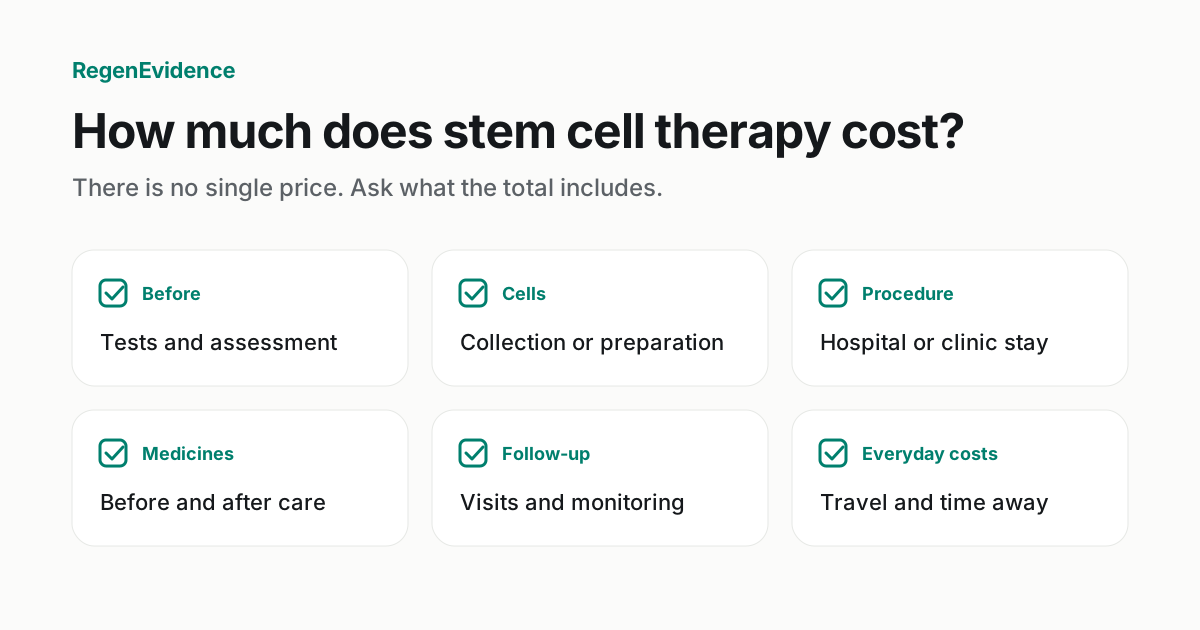
There is no single price
There is no single cost for stem cell therapy because it is not one treatment. A blood-forming stem cell transplant for a serious blood disease is major hospital care that can take months. Many other products sold as stem cell therapy are injections or infusions whose benefits have not been established. What you pay depends on the exact treatment, the reason for it, where you receive it, what the charge includes and what your insurance agrees to cover.127
Why does the cost vary so much?
A blood-forming stem cell transplant replaces blood stem cells after high doses of chemotherapy or radiation. It is used mainly for certain cancers and other blood disorders. It is very expensive because it involves long hospital stays at special treatment centers and care from many health workers.1
The type of transplant also matters. A transplant that uses cells from a donor may first require a search for a matching donor. The cost of that search depends on your insurance and on how many possible donors need testing.3
Treatments offered for joint pain, aging or many other conditions are a different situation. For most conditions, stem cell treatments are still experimental and have not been shown to be safe and effective. The US Food and Drug Administration (FDA) has warned about broad marketing of unapproved products described as regenerative medicine, including stem cell products. The seller sets the price. A price alone is not a sign that the product is approved or that it helps.710
What should a written estimate include?
Ask for an itemized estimate before you agree to treatment. It should list each expected item and service, not just the procedure. In the US, this is called a good faith estimate. If you are not using health insurance to pay, a provider usually must give you one when you ask. You should also get one when you schedule care at least three business days ahead.11
One estimate may not show the full picture. Each estimate covers a single provider or facility, so you may need one from the doctor and another from the hospital or clinic. Estimates can leave out care scheduled separately, care given by someone else, and extra care that no one expected.11
For a transplant, ask whether the total includes tests before treatment, a donor search if one is needed, and collecting the cells. Also ask about chemotherapy or radiation before the transplant, the hospital stay, medicines and follow-up visits.13456
For an injection or infusion offered outside a transplant center, ask exactly what the charge covers and what other costs you may have. Ask, too, who would provide and pay for emergency care if something went wrong.9
Will insurance cover it?
It depends on the treatment, your diagnosis and your plan. Most insurance plans pay part of the cost of a transplant for certain cancers and other diseases. Even then, a plan may not cover every part. Some plans pay for the transplant itself but not for finding a donor or donated cord blood. You may still have copays for medicines and appointments.1346
Medicare, the federal health program for people 65 or older and some younger people with disabilities, has a national coverage policy for blood stem cell transplants. It covers transplants for listed conditions. For some conditions, it covers a transplant only if the patient takes part in an approved study, and it does not cover some other uses. When a transplant is covered, the needed steps are covered too, including collecting the cells and the high-dose treatment before the transplant. When it is not covered, none of those steps are. For uses the policy does not address, coverage is decided by local Medicare Administrative Contractors. Other health plans set their own rules.4512
Experimental treatments are different. In most cases, insurance companies and government health programs do not pay for them, so the person receiving treatment may pay the full amount.8
Ask your insurer about the exact procedure and diagnosis, ask whether approval is needed in advance, and get the answer in writing. If your plan denies a treatment your doctor recommends, you may be able to appeal.469
What if the treatment is part of a clinical trial?
Costs in a clinical trial usually fall into two groups. Routine care that you would need anyway, such as doctor visits, hospital stays and lab tests, is often covered by health insurance. Research costs include the study treatment and extra tests done only for the study. Insurance often does not cover them, but the study's sponsor may pay. Before you join, ask the study team which costs are covered and which are not.12
Paying for an experimental treatment is not the same as joining a responsible clinical trial. The International Society for Stem Cell Research (ISSCR) patient guidance lists not charging participants for the new treatment and monitoring as a feature of responsible trials. Ask the study team which costs you or your insurer would pay. You may still have other costs, such as routine care or travel.812
Does the price tell you whether it helps?
No. A price shows what someone charges. It does not show whether a treatment has been shown to help your condition, whether it is approved for that use, or whether insurance will pay. People who pay for unproven treatments take on both health and financial risks, even when the cells come from their own body.710
FDA guidance for patients says regenerative medicine therapies have not been approved to treat conditions such as osteoarthritis, back pain or knee pain. FDA has also received reports of serious harm, including infections and blindness, linked to unapproved products.10
Costs and rules also differ from country to country. A lower charge somewhere else is not evidence that a treatment is approved, safe or effective. If treatment would involve travel, find out what your health plan or travel insurance would cover, and in which countries.9
What other costs should I plan for?
For a transplant, costs continue after the cells are given. If you do not live near the treatment center, you may need to stay close by for weeks or months. Travel, parking, meals, temporary housing and childcare can add up. Complications can also be expensive to manage.13
After a transplant, most people take many different medicines and have many follow-up visits. Insurance coverage for these can vary widely.3
Time away from work matters too. People who have a transplant need an adult caregiver, and some families may need to live on one income for a while.36
For an injection or infusion, ask what follow-up is planned and for how long, and who pays if a serious complication happens.9
Where can I get help with costs?
If a transplant is being considered, talk about money early. Transplant centers have staff, such as financial coordinators, who can explain what your insurance will pay and what you may owe. Hospital social workers may know of programs that help beyond insurance.236
Hospital billing offices or financial counselors can tell you about options such as payment plans, reduced rates and patient assistance. Some organizations help with costs such as medicines, travel and lodging.2
What should I ask before I agree?
Bring these questions to the care team, the billing office and your insurer.
What exactly is the treatment, and what has it been shown to do for my condition?
Is it standard care, part of a registered clinical trial, or an unproven treatment?
Can I get an itemized written estimate from each provider and facility?
What is not included, such as tests, medicines, follow-up visits or care for complications?
Does my plan cover this treatment for my diagnosis, and do I need approval first?
What will my copays and deductible be, and what is my out-of-pocket maximum?
If something goes wrong, who provides emergency care, and who pays for it?24911
Also ask for one written plan that names the product, where the material comes from, how it is processed, the dose, how it is given, the condition being treated, and how many visits are included. Then ask which items are extra, including tests, travel, and care for complications after you go home.1120
These offers are different treatments
“Stem cell therapy” covers much more than blood or bone-marrow transplants. Around the world, people also encounter marrow concentrates, several different fat-derived products, donor cord cells, eye and skin grafts, and specialized cells grown from stem cells. These are different treatment families. They are not interchangeable versions of one treatment.
Costs depend on the exact product and the full care plan. For example, published offers include $3,600 to $4,600 for standalone US marrow-concentrate procedures and $5,000 to $11,000 for one Colombian provider's donor cord-cell packages. Those are different services, not evidence that one country is cheaper.1418
The list below includes established care, experimental treatments, and marketed offers worldwide. Being offered somewhere does not mean a treatment is approved, safe, or effective. Approval applies to a particular product, condition, and country. A price does not show whether a treatment has been shown to help.20
Labels that change the meaning
Cell source means where the material comes from, such as marrow, fat, or cord tissue.
Processing means whether it is concentrated on the same day, kept as small tissue pieces, or grown in a laboratory. “Culture-expanded” means cells have been grown to increase their number.
Whose cells: “autologous” means your own, and “allogeneic” means a donor's.
Delivery means how the material is given. An IV infusion, a joint injection, or a surgical graft is a route, not a separate kind of stem cell.
Some products below are mixtures or tissue grafts, not purified stem cells. MSC means mesenchymal stromal cell, often advertised as “mesenchymal stem cell.” The source, processing, and intended use still need to be specified.202122
Your own bone-marrow concentrate
Marrow is collected, usually from the hip, and concentrated without growing cells in a lab. This is often called bone-marrow aspirate concentrate, or BMAC. It contains a mixture of cells and other components, with only a small share of stromal progenitor cells. It is not a purified stem-cell dose. Orthopedic clinics offer or study it for joint wear, tendon problems, certain bone-healing problems, and other conditions. Evidence depends on the condition and the procedure.1421
Care can include assessment and sometimes imaging, marrow collection, processing, anesthesia, and a local injection, often as an outpatient. It may also be added to surgery, which changes the bill.
An undated US provider tariff, checked in November 2026, lists $3,600 to $4,600 across its one-area and bilateral standalone tiers, including anesthesia. The consultation is a separate visit. A UK menu lists £3,000 to £8,000, about $4,020 to $10,710, for one to three joints, with doctor and clinic fees, ultrasound guidance, and a six-week clinical follow-up. Neither span is a price range for one identical single-joint treatment.141617
Marrow cells grown in a laboratory
MSCs can be isolated from your marrow or a donor's and grown in a lab. This is different from same-day BMAC. Orthopedic uses are studied and marketed internationally. Specific donor-marrow MSC medicines have also been approved in Japan and the US for certain cases of graft-versus-host disease, a serious complication after a donor blood-stem-cell transplant. That approval does not establish benefit for arthritis or for wellness offers.232425
An own-cell program can require marrow collection, weeks of cell growth, quality testing, storage, and a return visit for image-guided injections. A donor-cell medicine may instead involve repeated hospital-supervised IV doses. People do not undergo marrow harvesting for that donor product.
A reliable, clearly scoped published range is not established here. Do not use a BMAC price or a cord-cell package price for this category. The main budget differences are laboratory manufacturing, repeat visits, dose, storage, and the number of treatment sites or infusions.2325
Mixed cells from your own fat
Fat may supply a mixed cell preparation, small pieces of tissue, or lab-grown MSCs. Some sellers use “SVF” loosely, so ask what processing is actually performed.22
Stromal vascular fraction, or SVF, comes from fat collected by a small liposuction procedure and then processed into a mixed cell population. SVF is not a purified MSC product, and it usually is not culture-expanded. It is studied or marketed for joint problems, wound repair, and cosmetic uses. Evidence and legal status depend on the preparation and the use.2022
Care can include fat collection, anesthesia, cell separation, and local injection, sometimes combined with a fat graft. The exact isolation method matters.
A Korean clinic-issued announcement dated September 2026 gives $2,200 to $4,500 for facial SVF injections, or $4,500 to $9,000 for facial fat grafting enriched with SVF. These are two different cosmetic offers, not knee-treatment or IV prices. The announcement does not itemize testing, anesthesia, follow-up, travel, or complication coverage. These are advertising claims about prices, not independent proof of what the preparation contains or what it achieves.26
Microfragmented fat tissue
Microfragmented adipose tissue, or microfragmented fat, is your fat washed and mechanically broken into smaller tissue pieces. Some of the surrounding structure remains. It is not the same as enzymatically isolated SVF or lab-expanded fat-derived MSCs, even though names sometimes overlap. It is offered and studied for knee arthritis and other orthopedic problems. It is not a universally established arthritis treatment.22
Care can include fat harvesting under local anesthesia, mechanical processing, and a local, often image-guided injection. UK private clinics describe a single outpatient session.16
A reliable, clearly scoped published range is not established here. Ask whether the fee covers collection, the processing device, injection guidance, more than one joint, and rehabilitation. A single published fixed fee cannot be turned into a range.
Fat cells grown in a laboratory
Cells can be isolated from fat and grown over several weeks. They can be your own or a donor's. Own-cell programs in Japan market uses including joint problems, chronic pain, diabetes, and aging-related concerns. Those offers should not be read as proven benefits. Separately, Japan's regulator lists a donor fat-derived MSC sheet approved in 2026 for specified forms of inherited skin fragility. That is a distinct product and use, not approval of a general-purpose fat-cell infusion.2437
Own-cell treatment usually separates fat collection from later cell administration. One published Japanese program describes four to six weeks of culture, then IV infusion or local injection. A donor-cell sheet instead involves manufactured tissue applied to the affected area.
An undated Japanese menu, checked in November 2026, lists standard 100-million versus 200-million-cell infusion tiers at JPY 2,750,000 to 4,950,000, about $17,370 to $31,260. These tiers appear under “Infusion.” The menu does not define a complete course. Consultation, tests, storage, and anesthesia also appear as separate fee items. The provider itself describes the procedure as unapproved, self-pay care. This range must not be applied to every fat-derived product or to the approved donor-cell sheet.172737
Donor cells from cord tissue
Wharton's jelly is the gel-like tissue inside an umbilical cord. MSCs isolated and grown from cord tissue are donor cells. They are marketed or studied for joint problems, inflammatory conditions, and many other uses. Broad anti-aging or multi-disease advertising is not evidence of benefit. These products are not the same as cord-blood transplants.151820
Donor screening and laboratory manufacture happen before treatment. The person receiving care does not need tissue harvested. Packages may involve IV infusion, local injections, testing, monitoring, and other therapies.
A Colombian provider's September 2026 range is $5,000 to $11,000 for expanded cord-cell packages with a four-day itinerary. It lists review, consultations, baseline tests, protocol imaging, physician delivery, and 12-month remote follow-up. The route varies, and the dose and session count are not fixed. A Thai provider's pages list THB 559,000 to 900,000, about $16,660 to $26,830, across 50-, 70-, and 100-million-cell tiers. The price list calls that program 3 to 5 days, and the treatment page calls the same prices a 5-day experience. The pages describe an IV program with tests, consultations, other IV therapies, airport services, and planned follow-up. The provider describes the cells as expanded umbilical-cord cells. These are separate package families, not one worldwide price range.15171836
Other birth-tissue products
Amnion, chorion, placenta, and amniotic fluid are donor-derived products. They may be membranes, tissue particles, or fluids rather than living stem-cell preparations. They are used as coverings or barriers in some wound and surgical care, and some products are marketed as injections for joint pain. A product name does not establish what cells it contains. Laboratory testing of nine commercial products found no living cells. That result should not be generalized to every birth-tissue product.32
A sheet applied during surgery is very different from a vial injected in a clinic. Culture-expanded cells from a birth tissue also need their own product identity and evidence. They should not be grouped with a processed membrane or fluid merely because they share a source.
A reliable, product-specific range is not established here. The important budget questions are the exact product, whether living cells are present, the amount used, and whether you are paying for an injection, a wound-care course, or an operation, not just a “stem cell” label.2032
A published example of transplant cost
The transplant sections above describe this care. It is established specialist care for selected blood cancers, blood disorders, and immune disorders. Blood-forming cells may come from peripheral blood, bone marrow, or donated cord blood. Those are collection sources. Autologous versus allogeneic describes whose cells are used. They are not the same as marrow-MSC or cord-tissue-MSC procedures.1
Care can include evaluation, cell collection or donor matching, conditioning treatment, IV cell infusion, infection monitoring, medicines, and long follow-up. Autologous care uses your cells. Allogeneic care can add a donor search and procurement, matching, and treatment to prevent or manage graft-versus-host disease. Care is delivered through transplant centers, often with hospital stays and time living nearby.
A March 2026 Indian hospital guide for children's transplants gives INR 1,000,000 to 4,000,000, about $10,650 to $42,590. It says this usually includes the procedure, hospital stay, medicines, and follow-up. This is a broad hospital-guide estimate across different transplant needs. It is not a binding package, an adult price, a national average, or a separate autologous and allogeneic range. It should not be used to estimate transplant costs in another country, and a lower figure elsewhere is not by itself a reason to travel for a transplant. Ask your transplant center's financial coordinator and your insurer what your own care would cost.39 Donor-procurement charges and the full cost of complications are not clearly itemized. Comparable current patient-payment ranges for the two transplant types are not established here.1719
Grafts for the eye and the skin
Limbal cells help renew the eye's corneal surface. A person's healthy limbal tissue can be sampled, grown, and surgically grafted back. The European Medicines Agency authorizes a specific own-cell product for adults with moderate to severe limbal stem-cell deficiency caused by eye burns, including chemical burns. This is not approval of stem-cell injections for any cause of blindness. Care can include specialist eye assessment, biopsy, laboratory growth, hospital eye surgery, medicines, and follow-up. A reliable total-care range is not established here. Product acquisition, biopsy, surgery, and recovery care are separate budget questions. A medicine's list price is not automatically the patient's bill.28
Cells from a person's skin can be grown into sheets of the outer skin layer. This is specialist care for extensive burns and some inherited skin conditions, not the same as a cosmetic “stem-cell facial.” Such care is available at selected specialist centers. Japan also has a regulated cultured-epidermis product for specified uses. Care can include a skin biopsy, laboratory growth, wound preparation, graft surgery, dressings, and often major hospital care. The grafted area and the underlying injury drive much of the bill. A reliable whole-treatment range is not established here. Ask for the cell-graft cost and the burn or wound-care hospital budget separately.2429
Specialized cells made in a laboratory
Embryonic stem cells and induced pluripotent stem cells, adult cells reprogrammed in a lab, can be used to make specialized cells. Examples include dopamine-producing nerve-cell precursors for Parkinson's disease, heart-muscle cells, and insulin-producing islet cells. The intended treatment is the specialized cell product, not an infusion of undifferentiated cells that can grow into many tissues.20243031
Many approaches remain in clinical trials. Japan's regulator lists conditional, time-limited approvals from March 2026 for specified Parkinson's and severe ischemic heart-failure products. These involve brain surgery or placing cell sheets on the heart, not a routine IV “stem-cell” package. A published diabetes trial used liver portal-vein infusion of islet cells with immune-suppressing medicines. Each product has its own eligibility rules, risks, and follow-up.2431
A reliable, comparable patient-payment range is not established here. Specialized manufacturing, surgery, medicines, and years of monitoring matter. A clinic's generic MSC price cannot be substituted.
Other tissue-specific MSC products also exist. Japan's regulator lists a 2026 own-cell, joint-lining MSC product used with surgical repair of certain meniscal injuries. This is one more reason a knee treatment's cell source and care plan matter. It does not validate every injection advertised for arthritis.24
Products that are not stem cells
Platelet-rich plasma, or PRP, is concentrated platelets from your blood. It is not stem cells. It is offered for joint and tendon problems and other uses. Evidence depends on the condition and the preparation. Care involves a blood draw, preparation, and a local injection, sometimes with imaging guidance. A US hospital price study published in 2024 found $350 to $2,815 per knee injection. This is not a whole-course or 2026 quote. Tests and other care are not standardized in that range.1333
Exosomes are particles released by cells, not cells. Conditioned medium is the liquid from cell culture and is not the same as a purified vesicle preparation. These products are studied and marketed internationally, including for skin and hair and for other advertised uses. Product identity, contamination control, and evidence must be checked. A Japanese menu checked in November 2026 lists JPY 600,000 to 1,950,000, about $3,790 to $12,320, across its 5 to 30 mL fat-cell-derived “exosome” infusion tiers. This is a volume-based menu span, not an independently verified vesicle dose, a national average, or a whole-course price. Tests, follow-up, and complication coverage are not itemized for these tiers.17273435
How to read a published price range
The care setting changes the budget. A hospital or academic center may bill specialist teams, facility charges, medicines, and prolonged monitoring for transplantation, eye or skin surgery, or a disease-specific cell medicine. A doctor's injection fee is not the same as a total hospital bill.
In a physician office or orthopedic clinic, separate the consultation and diagnostic imaging from harvesting, processing, anesthesia, injection guidance, facility fees, and rehabilitation. Check whether one joint or several joints are included.1416
At a standalone clinic, a cell dose, a single session, and a multi-session package are different purchases. Extra IV therapies or a higher cell count do not prove greater benefit.1518
A medical-tourism program can require more than one trip, for collection and later treatment, plus flights, lodging, transfers, and follow-up at home. A four-day or multi-day itinerary is not necessarily an inpatient hospital admission.15182527
In a clinical trial, ask which research costs the sponsor pays and which routine-care or travel costs remain yours. Taking part in a trial does not have one universal price, and it should not automatically be called free.12
IV, local injection, and intrathecal delivery, into the fluid around the brain and spinal cord, are routes, not cell types. They require different expertise, facilities, and monitoring. A local-injection price should not be reused for an intrathecal or surgical procedure.20
The converted amounts above use European Central Bank reference rates dated November 6, 2026, rounded to the nearest $10. Original currencies are shown because a provider's billing rate, exchange fees, and later rates can differ. Provider menus and advertisements are examples of offers, not independent national averages and not endorsements. They do not support a ranking of the cheapest country.17
The bottom line
The cost of stem cell therapy depends on what is being offered. A blood-forming stem cell transplant is costly, specialized care, and insurance often pays part of the cost for certain conditions. Many other stem cell offers are experimental, usually are not covered, and have not been shown to help. Before you pay, find out exactly what the treatment is, what it has been shown to do and what you will owe in total.178
This article provides general education, not personal medical advice.
Sources · 37
- 1Source 1(opens in a new tab)
Patient page · 2023
- 2Source 2(opens in a new tab)
Patient page · 2024
- 3Source 3(opens in a new tab)
Patient page
- 4Source 4(opens in a new tab)
Patient page
- 5Source 5(opens in a new tab)
Coverage policy · 2024
- 6Source 6(opens in a new tab)
Patient page
- 7Source 7(opens in a new tab)
Patient page
- 8Source 8(opens in a new tab)
Patient page
- 9Source 9(opens in a new tab)
Patient page
- 10Source 10(opens in a new tab)
Regulator page · 2021
- 11Source 11(opens in a new tab)
Consumer rights page · 2026
- 12Source 12(opens in a new tab)
Patient page · 2024
- 13Source 13(opens in a new tab)
Price study · 2024
- 14Source 14(opens in a new tab)
Advertised price menu
- 15Source 15(opens in a new tab)
Advertised price menu · 2026
- 16Source 16(opens in a new tab)
Advertised price menu · 2026
- 17Source 17(opens in a new tab)
Exchange-rate table · 2026
- 18Source 18(opens in a new tab)
Advertised price page · 2026
- 19Source 19(opens in a new tab)
Hospital cost guide · 2026
- 20Source 20(opens in a new tab)
Professional guidance · 2021
- 21Source 21(opens in a new tab)
Research article · 2021
- 22Source 22(opens in a new tab)
Research article · 2023
- 23Source 23(opens in a new tab)
Regulator announcement · 2024
- 24Source 24(opens in a new tab)
Regulator list · 2026
- 25Source 25(opens in a new tab)
Advertised care page
- 26Source 26(opens in a new tab)
Advertised announcement · 2026
- 27Source 27(opens in a new tab)
Advertised price menu
- 28Source 28(opens in a new tab)
Regulator page · 2026
- 29Source 29(opens in a new tab)
Patient education · 2025
- 30Source 30(opens in a new tab)
Patient education · 2023
- 31Source 31(opens in a new tab)
Research announcement · 2025
- 32Source 32(opens in a new tab)
Research article · 2021
- 33Source 33(opens in a new tab)
Patient page
- 34Source 34(opens in a new tab)
Safety notice · 2020
- 35Source 35(opens in a new tab)
Research article · 2023
- 36Source 36(opens in a new tab)
Advertised care page · 2026
- 37Source 37(opens in a new tab)
Advertised care page
Ask a question in your own words. A question stays on the ask page. It is not added to this article or to a share link.
For learning only. Not medical advice. Talk to your doctor.