Does stem cell therapy work for hair loss?
Published .
Not clearly. Small trials show short-term hair-count changes in pattern hair loss. No stem cell product is FDA-approved for this use.
The short answer
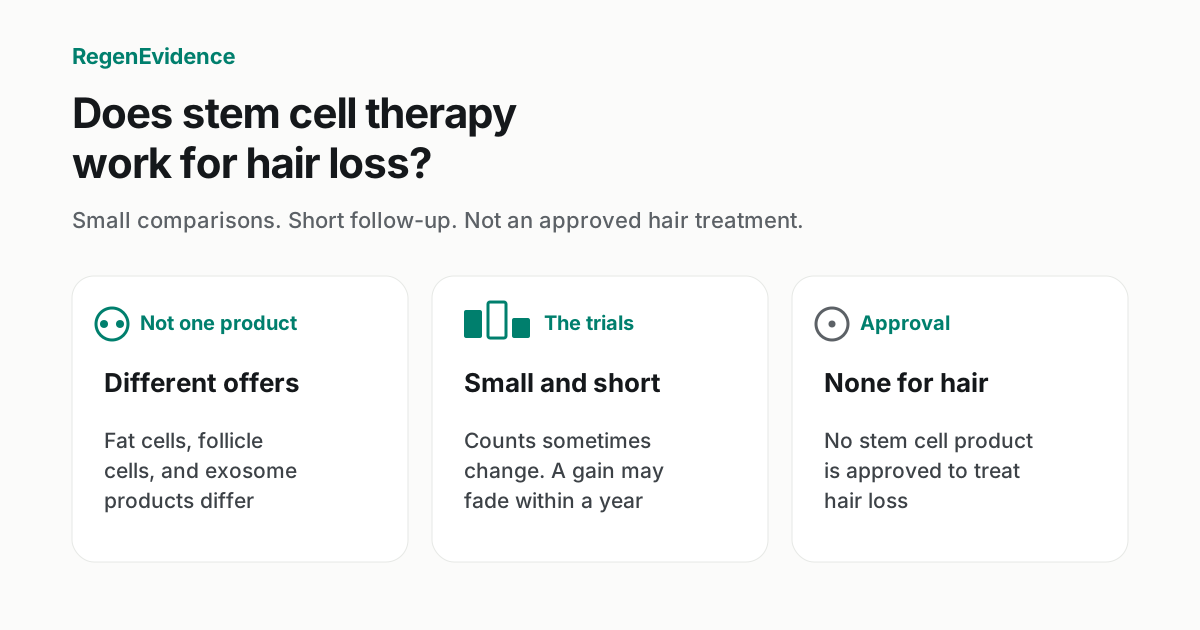
Not clearly. Stem cell therapy for hair loss is not one treatment. In small trials, mostly of pattern hair loss, some preparations were tied to a short-term rise in hair counts. The products differ, and the comparisons are small. When a hair count rises, the rise is often small, short-lived, or no larger than in the comparison group. No stem cell product is FDA-approved for hair loss.1456
Medicines with a longer record are still the usual place to start. Those include minoxidil on the scalp and, for many men, a pill called finasteride.10
These offers are not one treatment
Clinics use one name for several different preparations. A finding for one does not apply to the others.56
Some offers start with your own fat. A clinician removes a sample, often by liposuction, and can inject the fat itself. Or the sample is processed into a stromal vascular fraction. The FDA lists stromal vascular fraction, which it also calls fat-derived cells, among regenerative products. Those products need FDA oversight in a trial before approval, whether they come from your body or someone else's.16
A different product is not a syringe of living cells. Conditioned medium is the liquid cells were grown in, after the cells are removed. An extract can be made by breaking cells open. The cells may come from a donor.78
Another approach uses cells from your own hair follicles. Follicles are the roots that grow hair. In one trial, researchers took the sheath around follicle roots from the back of the scalp, grew those cells, and injected them into thinning spots. A clinic that advertises a follicle-cell suspension is not necessarily using that same preparation.59
A further group is sold as umbilical cord blood, Wharton's jelly, amniotic fluid, or exosomes. The FDA says there are currently no FDA-approved exosome products. Cord-blood stem cell products described on the FDA's patient pages are approved for disorders that affect the making of blood, and those products are not approved for other uses. A separate bone-marrow cell product, approved in 2024, is for a transplant complication in children. Hair loss is not its approved use.1234
Which kinds of hair loss
Most of the trials below enrolled people with pattern hair loss. Doctors call it androgenetic alopecia. It is the most common cause of hair loss in men and women. It often affects the top of the head, and it can run in families.611
Patchy hair loss, called alopecia areata, is a different condition. The immune system attacks the follicles. Hair may regrow without treatment within a year. For a few patches, steroid injections into the skin are a usual treatment. The fat-cell trial below left out people with active alopecia areata. The stem cell comparisons on this page do not show a result for that condition.61011
Hair can also shed after a major illness, childbirth, a new medicine, or a problem such as a hormone imbalance. Finding the cause comes first. That can take an exam and sometimes blood tests or a small sample of scalp. Treating that cause is a different step from injecting cells.1011
What the comparisons show
A 2024 review searched through October 2023. The reviewers said they found 12 randomized trials, covering 514 people, of cell or cell-derived treatments for pattern hair loss. They did not combine the trials into one number. The treatments, methods, and people studied varied too much.5
A randomized trial of fat plus regenerative cells enrolled 71 people with early pattern hair loss, 54 men and 17 women. Each person had one treatment on a patch of scalp measuring 40 square centimeters. Sixteen people received fat plus a higher cell dose. Twenty-two received fat plus a lower cell dose. Twenty-four received fat alone. Nine received salt water. At 24 weeks, in the whole group, terminal hair counts and hair width were not statistically different across those groups. In plain terms, the study did not show a difference large enough to stand out from chance. Terminal hairs are the thicker, mature hairs.6
The authors then looked at a smaller group of men with early hair loss. In that group, terminal hair counts in the lower-dose group rose by an average of 16.56 from each person's starting count at 24 weeks. The spread around that average was 14.68, almost as wide as the gain. That rise was statistically larger than in the salt-water group. The paper calls this an ad hoc look at men with early hair loss. The trial's main goal was safety, and it was not sized in advance to prove a difference. By one year the gain had faded. The difference from salt water was not statistically significant. The company that paid for the trial also helped design it, analyze it, and write the paper. One author is an officer of that company and owns stock in it.6
A separate trial tested a liquid made by breaking open fat-derived cells from donors. It was not an injection of your own cells. Thirty-eight adults with pattern hair loss, 29 of them men, applied the liquid or plain water twice a day for 16 weeks. Thirty-four people finished. In the photographed patch, the liquid group gained 3.68 hairs per square centimeter and the water group gained 1.21. The difference between groups was statistically significant. The authors also describe this as a 28.1 percent rise versus a 7.1 percent rise. The patch started at 13.95 hairs per square centimeter in the liquid group and 17.58 hairs per square centimeter in the water group, so the percent looks larger than the number of hairs. A clinician scoring photos did not find a statistically significant difference. Seven mild reactions occurred in five people, and those reactions went away without treatment.7
A third trial enrolled 37 men. One side of the scalp was injected with liquid that donor fat-derived cells had been grown in. The other side was injected with salt water. Both sides also received minoxidil, rubbed on twice a day. Injections were every 2 weeks for 6 weeks. Hair measures rose on both sides. The cell liquid was not statistically better than salt water. The authors say 6 weeks is too short to see the full course of growth. They also hypothesize that treating only one side may have let the liquid diffuse to the salt-water side.8
A trial of cells from each person's own follicles enrolled 50 men and 15 women, ages 33 to 64, with pattern hair loss. Cells from the sheath around follicle roots on the back of the scalp were grown and injected once. Each person had four spots, assigned by chance to three doses or a placebo. A placebo is an inactive comparison. At the lowest dose, total hair density and the combined diameter of the hairs were higher than in the placebo spot at 6 and 9 months. Men and women had similar changes. There were no serious adverse events. The benefit was temporary and was seen through 9 months.9
The same 2024 review said it found no published randomized trial of exosomes for pattern hair loss through October 2023. A clinic product sold as exosomes is not automatically the same as a research preparation.235
What a procedure involves
The steps depend on the product. What follows is how the studies were done, not a schedule for one person.6789
In the fat trial, fat was removed by liposuction under local anesthesia, sometimes with medicine to make the person drowsy. The fat was processed. It was then placed under the skin of a marked patch. The salt-water group got salt water in place of fat. A second set of injections put either the cell mixture or a salt-water solution into the skin. The patch was 40 square centimeters, not the whole scalp. People were checked for up to a year. There were no serious adverse events, and no one left the study because of one. The study ran under an FDA investigational device exemption. That is oversight of a study. It is not an approval to sell the procedure for hair loss.16
The follicle-cell trial started with tissue from the back of the scalp. The cells were grown, then injected once into small areas.9
The donor-cell liquid was applied by the person, twice a day, for 16 weeks. The conditioned-medium trial used numbing cream, then many small injections about a centimeter apart, every 2 weeks, for 6 weeks. People reported pain, itch, and redness after injections, and those effects settled. Most skin irritation in that trial was described with the minoxidil.78
Risks that are known
The hair trials described here mostly report short-term local reactions. They do not follow people for many years. That is a thin safety record for a product a clinic prepares on its own.6789
The FDA lists other risks for unapproved regenerative products, including stem cells, fat-derived cells, cord blood, and exosomes. The material can come from your body or from someone else. The list includes bacterial infection, including life-threatening blood infection, unwanted immune reactions, reactions where tissue is taken or injected, cells growing in an unintended way, and contamination with bacteria, viruses, or mold during preparation. The agency has also received reports of blindness and tumor formation with some products in this group. Those reports are not a rate for every scalp injection. The hair trials above did not report blindness or tumors. The reports do show that serious harm has happened with unapproved products sold as regenerative treatment.1
For exosomes, the FDA in 2019 reported serious adverse events, including bacterial infections, in patients in Nebraska who were treated with unapproved products marketed as containing exosomes.3
If you are charged for stem cells, fat-derived cells, cord blood, or exosomes outside a clinical trial, the FDA says you are likely being deceived and offered a product illegally. A page on a trial registry, or a claim that a firm registered with the FDA, does not mean the product is legally marketed.1
How this compares with usual care
Pattern hair loss already has options with a longer record than these cell studies.1011
Minoxidil is applied to the scalp. A dermatology society's patient page says it can help early hair loss, and that it cannot regrow an entire head of hair. Many people need 6 to 12 months to see a change. If you stop, you lose the benefit.10
That page says the FDA approved finasteride to treat male pattern hair loss. It is a daily pill. It tends to help more when it is started early, and hair loss returns if it is stopped. A large medical center's patient page says rare side effects include a lower sex drive, problems with sexual function, and a higher risk of prostate cancer. Women who are pregnant, or who may become pregnant, need to avoid touching crushed or broken tablets. That page also lists spironolactone and dutasteride among other pills.1011
The medical-center page says the FDA has approved a low-level laser device for hereditary hair loss in men and women, and that a few small studies have shown better hair density. The dermatology page says not everyone who used a laser saw regrowth, and that more study is needed on long-term effects.1011
A hair transplant moves your own follicles from a place that still has hair into a thinning area. It does not create new follicles from a stem cell product. One patient page calls a transplant a lasting option for pattern baldness. The medical-center page says hereditary hair loss will eventually progress despite surgery. It also says this surgery is painful enough that sedation is used, and that risks include bleeding, bruising, swelling, and infection. More than one operation is sometimes needed.1011
Platelet-rich plasma is a different procedure. Blood is drawn, spun, and the platelet-rich part is injected into the scalp. It is not a stem cell product. The dermatology page says studies support it as a hair-loss treatment, that a session takes about 10 minutes, and that people often return once a month for 3 months and then every 3 to 6 months. Those studies are a separate body of evidence from the cell trials on this page.10
Who the studies left out
The fat trial left out people who were pregnant or trying to become pregnant. It left out people with active alopecia areata or another active autoimmune disease, people being treated for cancer, and people with diabetes or a thyroid disorder. It also left out people who had used minoxidil in the prior 6 months, or finasteride or dutasteride in the prior 12 months. Those rules describe who was studied. They are not a decision for one person.6
The follicle-cell trial enrolled adults ages 33 to 64 with pattern hair loss. It does not describe children. It also does not describe a scalp that is already smooth, with no hair left to count. Minoxidil, on the dermatology page, cannot regrow an entire head of hair. A transplant needs a place to take follicles from.910
If the shedding has a separate cause, such as a medicine, a recent illness, or a hormone imbalance, the patient pages say to look for that cause. A cell procedure does not replace that step.1011
Cost and insurance
This page does not list a price. Charges are not the same in every office. A dermatology society's page says insurance generally does not cover the cost of hair-loss treatment. A medical-center page says surgical procedures to treat baldness are not usually covered by insurance.1011
Cell and exosome products are not approved for hair loss. Ask your plan, in writing, whether it pays for the exact procedure, the visit, and follow-up. Ask the clinic what is included before you agree. If the offer is a study, ask which bills the study pays and which it does not. Being charged for stem cells, fat-derived cells, cord blood, or exosomes outside a trial is the situation the FDA warns about.11011
Questions to ask a clinician
What is causing my hair loss? Is it pattern hair loss, patchy hair loss, or a cause that has its own treatment?1011
What would actually be used: my own fat, a processed cell fraction, a donor liquid, my own follicle cells, cord blood, Wharton's jelly, amniotic fluid, or exosomes? Were the cells grown in a lab?169
Is any stem cell or exosome product approved by the FDA for hair loss? If this is a study, who oversees it, and can I read the consent form before I pay?13
What did a comparison show for this exact preparation, in people whose hair loss looks like mine, and how long were they followed?689
What problems have occurred in people treated here, including infection, and who answers if one starts after I go home?16
How does that compare with minoxidil, with finasteride if it is an option for me, with a laser device, with a transplant, or with platelet-rich plasma?1011
Will my health plan pay any of this? If it will not, what does the full plan include?1011
The bottom line
Stem cell therapy has not been shown to be a reliable treatment for hair loss. The name covers different products. In the comparisons described here, a fat-cell procedure did not beat its comparisons in the whole group, a donor-cell liquid added a few more hairs than water in a small trial, and a conditioned medium did not beat salt water when both sides also got minoxidil. A follicle-cell injection was tied to a temporary change in a small trial. No stem cell product is FDA-approved for hair loss. Minoxidil, and finasteride for many men, have a longer record.1678910
This page is for learning. It is not personal medical advice.
Sources · 11
- 1Source 1(opens in a new tab)
Regulator page · 2021
- 2Source 2(opens in a new tab)
Regulator page · 2020
- 3Source 3(opens in a new tab)
Regulator page · 2019
- 4Source 4(opens in a new tab)
Regulator page · 2024
- 5Source 5(opens in a new tab)
Journal review · 2024
- 6Source 6(opens in a new tab)
Randomized trial · 2020
- 7Source 7(opens in a new tab)
Randomized trial · 2020
- 8Source 8(opens in a new tab)
Randomized trial · 2023
- 9Source 9(opens in a new tab)
Randomized trial · 2020
- 10Source 10(opens in a new tab)
Patient page · 2022
- 11Source 11(opens in a new tab)
Patient page · 2026
Ask a question in your own words. A question stays on the ask page. It is not added to this article or to a share link.
For learning only. Not medical advice. Talk to your doctor.