Does stem cell therapy work for knee arthritis?
Published .
Not clearly. Stem cell shots for knee arthritis may ease pain slightly for a few months, but the evidence is weak and cartilage regrowth is unproven.
The short answer
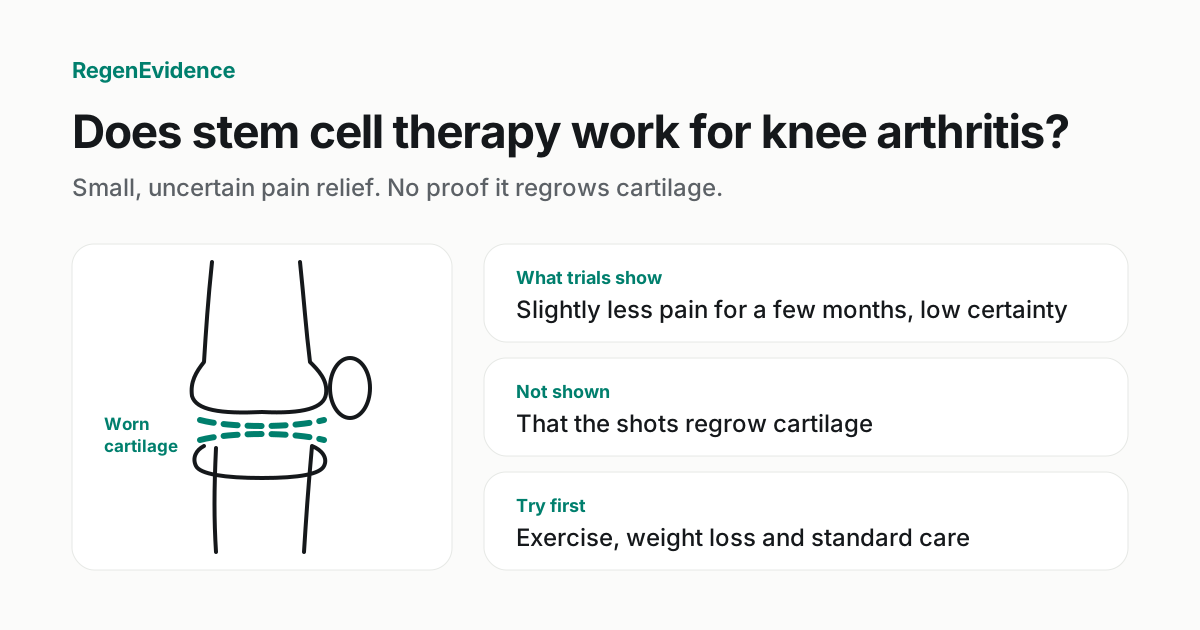
Not clearly. In trials that compared stem cell injections with a fake (placebo) shot, people who got stem cells reported slightly less knee pain for up to six months. But the experts who pooled those trials rated the evidence as low certainty. No trial has shown that these shots slow arthritis or rebuild the knee.1
In the US, no stem cell product is approved to treat knee arthritis.6 Expert groups also disagree on how to view these shots. One major US arthritis guideline from 2026 strongly advises against them. Another 2026 guideline says the evidence is too weak to recommend for or against them.34 For now, they are best seen as an experimental treatment, not a proven one.
What is knee arthritis?
Knee osteoarthritis is the most common type of knee arthritis. Over time, the cartilage that cushions the ends of the bones breaks down, and other parts of the joint change too. This can cause pain, stiffness and trouble walking or climbing stairs.1
Most treatments aim to ease pain and help you move better. Joint replacement surgery is usually saved for severe arthritis when other treatments have not helped.1
What does stem cell therapy for the knee mean?
It usually means an injection into the knee joint. The cells can come from different places:
Your own bone marrow, drawn from the hip bone and spun down to concentrate it.45
Your own fat, taken with a small liposuction-type procedure and then processed.45
Donor tissue, such as umbilical cord tissue or other birth tissue.27
These products are not the same. The source, preparation and dose of cells vary from study to study, so results from one product do not prove anything about another.1 One 2026 guideline notes that most commercially processed amniotic products, made from placenta membranes or fluid, do not contain living stem cells.4 Platelet-rich plasma (PRP) is a different treatment that does not use stem cells.7
How is it offered around the world?
Rules differ a lot by country. In the US, regulators say these therapies have not been approved for any orthopedic condition, including knee pain and arthritis. Products that need FDA approval are meant to be given only in a clinical trial with FDA oversight until they are approved. A narrow exception can apply when your own tissue is removed and put back into you during the same surgical procedure. That exception is not an approval and does not show that a procedure works.610 In Canada, stem cells are not an approved treatment for osteoarthritis.7
South Korea's drug regulator approved one donor stem cell product in 2012. It is made from umbilical cord blood. It is approved for a specific use: severe cartilage damage in the knee in people with osteoarthritis, placed during surgery or through a small camera procedure.8 That is a narrow approval. It is not the same as a joint injection sold at a clinic.
Clinics in many countries advertise stem cell shots for knee pain. Standards for these clinics can be different from those at home.7 An offer being legal or easy to buy in one place does not show that it is safe or effective.
What does the research show?
Pain and function. A large review published in 2025 found 25 randomized trials with 1,341 people. Eight trials compared stem cell injections with a placebo shot. In the seven that reported pain, with 445 people, average pain up to six months later was 4.5 out of 10 after a placebo shot and 3.3 after stem cell shots. Daily function may also have improved slightly more.1
Those findings are uncertain for several reasons. Most trials were small. The cell source, preparation and dose varied a lot. And up to three larger trials were done but never reported their results.1
Compared with a steroid shot. One of the largest trials, done in the US, gave 480 people with knee arthritis one of three cell injections or a standard steroid shot. The cells came from bone marrow, fat or donated umbilical cord tissue. Pain improved in every group. But after one year, none of the cell injections did better than the steroid shot or better than each other.2
Other reviews. Some smaller reviews report bigger benefits for certain cell types, such as cells from fat. A 2026 guideline that weighed these studies rated the overall evidence as very low certainty.4
Can stem cells regrow knee cartilage?
There is no good evidence that they do in people with knee arthritis. In the 2025 review, no included trial measured whether arthritis got worse on X-rays.1 In the large US trial, MRI scans showed no meaningful joint change after one year in any group, including the cell injections.2 Studies have not consistently shown lasting improvements in joint health.5
Be careful with claims that a shot will rebuild your knee, reverse arthritis or let you avoid knee replacement. The research does not show this.
What do expert guidelines say?
A 2026 guideline from a major US group of arthritis specialists strongly recommends against stem cell injections for knee and hip arthritis.3
A 2026 guideline written for the US veterans' and military health systems is more neutral. It says there is not enough evidence to recommend for or against stem cell injections for knee arthritis. It rated the evidence as very low quality.4
Both guidelines support standard options such as exercise or physical therapy and weight loss when needed.34
What happens during the procedure?
Steps depend on the product. With your own cells, the first step is collecting them. Bone marrow is drawn with a needle from the top of the hip bone and spun down. Fat is removed with a liposuction-type procedure and then processed.45 Donor products skip this collection step.7
Next, the cells are injected into the knee. In research, this is often done with ultrasound to guide the needle.24 Ask how many shots are planned, what else will be injected with the cells, and what follow-up you will get.7
Recovery and side effects
In trials, the most common problems were short-term pain, swelling and bruising where cells were taken or injected. In the large US trial, swelling and bruising were more common with some cell injections than with the steroid shot. No serious problems linked to the procedure were reported in that trial.2
Any joint injection carries a small risk of joint infection. Some risks are still unknown, especially for donor cells and for treatments that may cause cells to grow.1 Donor products can carry risks such as infection and immune reactions.7 US regulators have received reports of serious harms, including infections, from unapproved products.6
You will need follow-up to watch for side effects.7 A joint infection needs urgent care. Warning signs include sudden severe joint pain, not being able to move or put weight on the joint, hot or swollen skin over the joint, and fever.9
Who might consider it?
Most trials enrolled adults in their 50s and 60s with mild to severe knee arthritis.12 People respond differently. Some report pain relief, and others do not.7 Because benefits are uncertain, guidelines put standard treatments first.34
In the US, cell products that need FDA approval are meant to be given only in a clinical trial with FDA oversight until they are approved.6 If you still want to try a cell treatment, ask whether a registered trial is an option. A listing on ClinicalTrials.gov, or a claim that a product is registered with the FDA, does not by itself mean the product is legally marketed or that the study has FDA oversight.6 Talk with a clinician who knows your knee and your health history.
What treatments have stronger evidence?
Treatment guidelines recommend these options. Support is strongest for the first four:
Exercise, with help from a physical therapist when needed.3
Weight loss, for people with overweight or obesity.34
Anti-inflammatory pain medicines, as gels or pills, when they are safe for you.3
Steroid injections into the knee for pain relief.3
Knee braces, canes and other walking aids, as needed.3
Mind-body exercise such as yoga, which has weaker support.3
Joint replacement is an option for severe arthritis when other treatments have not helped.1
Cost and insurance
Stem cell injections for knee arthritis are often costly. Because they are experimental, health insurance often does not cover them, so many people pay out of pocket.4 One Canadian health service warns that people who go to clinics in other countries must pay all the costs themselves.7
Before you agree to anything, ask for a written list of what the charge includes, such as collection, processing, imaging, follow-up visits and extra shots. Then ask your insurer what, if anything, it will cover.57
Questions to ask before you decide
What exactly is in the injection? Are the cells from my bone marrow, my fat or a donor?7
What benefit can I realistically expect, and how will we know if it is helping?5
What do randomized trials show for this exact product?1
Is this part of a registered clinical trial with oversight?6
What are the risks, and who handles problems if they happen?7
How many patients did not get better?7
What follow-up will I get after the treatment?7
Should I try evidence-based treatments first? Will insurance cover any of this?5
The bottom line
Stem cell injections for knee arthritis are still experimental. The best evidence suggests they may ease pain slightly for a few months, but that finding is uncertain. They have not been shown to rebuild cartilage, they are not approved in the US for this use, and long-term safety is not fully known.126 Talk with a clinician you trust about treatments with stronger evidence and about whether a research study might be right for you.6
This article is for general education. It is not medical advice and does not replace advice from a clinician who knows your health history.
Sources · 10
- 1Source 1(opens in a new tab)
Review summary · 2025
- 2Source 2(opens in a new tab)
Trial report · 2023
- 3Source 3(opens in a new tab)
Guideline summary · 2026
- 4Source 4(opens in a new tab)
Clinical guideline · 2026
- 5Source 5(opens in a new tab)
Patient guide · 2026
- 6Source 6(opens in a new tab)
Regulator page · 2021
- 7Source 7(opens in a new tab)
Health service page · 2023
- 8Source 8(opens in a new tab)
Regulator listing
- 9Source 9(opens in a new tab)
Health service page
- 10Source 10(opens in a new tab)
Federal regulation
Ask a question in your own words. A question stays on the ask page. It is not added to this article or to a share link.
For learning only. Not medical advice. Talk to your doctor.