Does stem cell therapy work for multiple sclerosis (MS)?
Published .
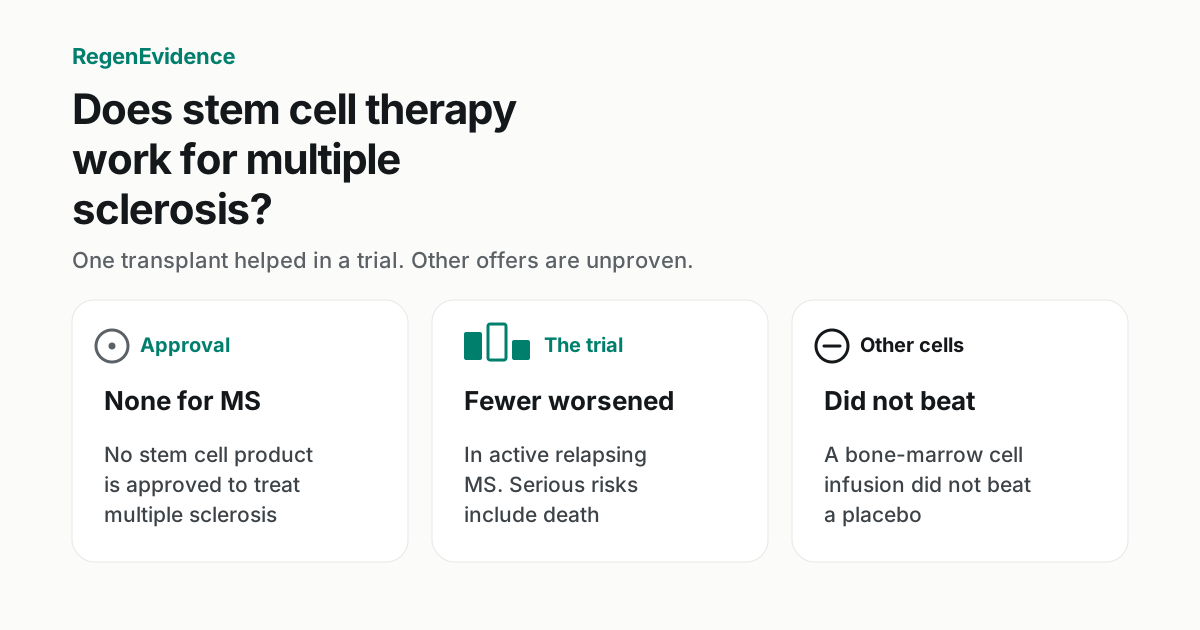
A transplant of your own blood-forming stem cells has trial evidence in active relapsing MS, with serious risks. Other stem cell injections are unproven.
The short answer
It depends on the procedure. Autologous hematopoietic stem cell transplantation, shortened to aHSCT, uses your own blood-forming stem cells after chemotherapy. In a randomized trial of people with very active relapsing-remitting MS, disability got worse in 3 people in the transplant group and 34 people in the medicine group. Relapses in the first year were also less common after the transplant. That procedure can cause infections, infertility, and, rarely, death. It is not an FDA-approved product for MS.16
Other offers are a different treatment. Mesenchymal cells from bone marrow, given once into a vein, did not beat a placebo on active MRI spots in a 144-person trial. A placebo is an inactive comparison. The FDA says no regenerative medicine therapy is approved to treat MS. A paid injection of fat cells, cord cells, or similar products is not the transplant that trial tested.19
What MS is
Multiple sclerosis (MS) is a long-term condition of the brain and spinal cord. The immune system, which usually fights germs, attacks myelin. Myelin is the fatty cover around nerve fibers. The attack leaves scar-like spots that an MRI scan can show. Symptoms depend on where those spots are. They can include vision trouble, weakness, numbness, trouble walking, bladder problems, fatigue, and changes in thinking or mood. MS often starts in young adults, and it affects people differently.23
The most common starting course is relapsing-remitting MS. Symptoms flare, then ease fully or partly. Weeks, months, or years can pass before the next flare. Many people later move into secondary progressive MS, in which symptoms are more steady and slowly get worse. Primary progressive MS is less common. It worsens from the start, without clear flares. Medicines called disease-modifying therapies can reduce how often relapses happen in relapsing MS.23
Stem cell offers are not one treatment
The cells, the drugs given with them, and where they go in the body all change what a study can say. A finding for one preparation does not apply to the others.14
aHSCT uses hematopoietic stem cells, the cells that make blood. Drugs move them out of your bone marrow and into the blood so they can be collected and stored. Chemotherapy then wipes out much of the immune system, including cells that are attacking myelin. The stored cells are given back so blood and immune cells can grow again. Those new cells do not regrow damaged nerves in the brain or spinal cord. The aim is to stop the immune attack, not to rebuild the spots MS has already scarred.45
Mesenchymal stromal cells, also called mesenchymal stem cells, are a different cell from bone marrow or other tissue. They are not the blood-forming cells used in aHSCT. Clinics also sell material from fat, umbilical cord blood, amniotic fluid, or tiny packets called exosomes. The FDA groups those as regenerative medicine products, whether they come from your body or someone else's. It says they are not approved to treat any neurological disorder, including MS. The FDA says the only stem cell products it has approved are cord-blood products for disorders that affect the making of blood. Those products are not approved for MS.19
What the transplant trial showed
The published randomized trial of this transplant in MS enrolled 110 people with relapsing-remitting MS at centers in the United States, Europe, and South America. It did not include primary or secondary progressive MS. People were 18 to 55 years old, with a disability score from 2.0 to 6.0 on the Expanded Disability Status Scale. That score runs from 0 to 10. A higher number means more disability. Each person had already had at least two relapses in the prior year while on treatment, or one relapse plus an active MRI spot at another time. Fifty-five people were assigned to the transplant. Fifty-five stayed on disease-modifying therapy, changed to a stronger medicine or a different class, as their neurologist chose. A neurologist who did not know the assignment scored disability. People in the medicine group could switch to the transplant later if disability got worse after at least a year, so the main comparison is the one made before that switch.6
The middle of follow-up was 2 years. The average was 2.8 years. Ninety-eight people were checked at 1 year. Only 23 were checked every year out to 5 years. Disability got worse in 3 people in the transplant group and 34 in the medicine group. Worse meant a rise of at least 1 point on the disability score, seen twice, 6 months apart, after at least a year. A comparison called a hazard ratio was 0.07, with a likely range of 0.02 to 0.24. A number under 1 means those worsening events happened less often after the transplant. During the first year, the average disability score improved from 3.38 to 2.36 in the transplant group and worsened from 3.31 to 3.98 in the medicine group. In that first year, 1 of 51 people in the transplant group had a relapse, compared with 36 of 52 in the medicine group. There were no deaths in either group. No one who received the transplant had a life-threatening problem outside the blood counts, such as a heart attack or sepsis. The authors called the study preliminary. They said it needs to be repeated, with longer safety follow-up.6
Who that evidence is about
The people in that trial had very active relapsing MS that had already broken through treatment. They were not people with progressive MS and no recent inflammation. A 2021 statement from the National Multiple Sclerosis Society says aHSCT may be a useful option for relapsing MS that still causes relapses or new inflammatory spots despite a high-efficacy medicine, or when those medicines cannot be used. High-efficacy here means a stronger MS medicine. The statement says the people most likely to fit are younger than 50, with MS for less than 10 years, and that the procedure should be done only at centers with substantial experience. It also says larger trials are still needed against the strongest medicines now in use.8
A 2025 European consensus of MS and transplant specialists, with its literature updated through June 2024, says to consider the transplant when highly active MS has failed one high-efficacy medicine, and to refer people early. Using it as the very first treatment should be limited to MS that is worsening quickly and has a poor outlook, and then only inside a trial or a formal study. Age under 45, disease shorter than 10 years, and a disability score under 6 are described as a picture of who tends to be suitable. The consensus says those numbers illustrate the pattern. They are not hard cutoffs, and they are not a decision for one person. Heart, lung, kidney, infection, and mental health checks come before a transplant team says yes.7
What a transplant does not repair
The transplant targets the immune attack. The new blood-forming cells do not regrow damaged nerves, and the procedure cannot undo all the damage MS has already done. Some people in studies have had disability scores improve after inflammation quiets. That can happen because ongoing inflammation stops. It is not the same as repairing old scars, and it does not happen for everyone.46
For progressive MS with no recent relapses and no new inflammatory MRI spots, the 2025 consensus says offering this transplant is not supported. It also says the transplant is not recommended for long-standing, advanced MS with severe disability, because the risk is high and the benefit is low or absent. No randomized trial built only for progressive MS has been published. The US trial that is still recruiting includes relapsing MS, and its registry says relapsing MS covers both relapsing-remitting MS and secondary progressive MS. That trial has not reported results, so it does not yet show whether the transplant helps progressive MS.710
Mesenchymal cells were studied in part because of a hope they might protect tissue. In the 2021 trial, 144 people with active relapsing or progressive MS, ages 18 to 50, received one intravenous dose of their own bone-marrow mesenchymal cells or a placebo, then crossed over at 24 weeks. The cells did not reduce active MRI spots. The rate ratio was 0.94, with a likely range of 0.58 to 1.50. That is not a clear difference. The authors said this does not support using those cells to treat active MS, and that questions about tissue repair still need their own studies. Few serious problems in that one trial are not a safety record for a product a clinic prepares.9
What the procedure involves
The steps below are the usual shape of aHSCT, as a UK patient group describes them for the kind of transplant used there. A center can change details. This is not a personal schedule.5
Shots, including chemotherapy and a lab-made growth factor called G-CSF, move stem cells from the bone marrow into the blood. Those shots are often given as an outpatient visit. MS symptoms can get temporarily worse at this step. About 10 days later, when enough stem cells are in the blood, they are collected through a tube in the arm or neck and stored. If too few cells are collected, the shots may be repeated. Chemotherapy then follows in the hospital, over several days. That chemotherapy is the part that wipes out immune cells. The stored cells are returned by a drip, often the same day or the next day. New blood and immune cells usually start to appear about 10 to 30 days later.5
While the new immune system is still weak, infection is easier to catch. People are usually kept in a hospital room to lower that chance, with antibiotics and, when needed, blood transfusions. The UK patient group says the stay in that room is around four weeks. After going home, people are advised to limit contact with others for about three months. Recovery often takes two to six months. For some people it takes more than a year. Ask the center how long its own patients stay, and who answers if a fever starts after you leave.5
Conditioning is the name for the chemotherapy plan. A 2025 consensus recommends an intermediate-intensity plan for most people with MS. Two common ones are a four-drug plan called BEAM plus antithymocyte globulin, which clears immune cells, or cyclophosphamide plus that same immune-cell drug. The randomized trial used the cyclophosphamide plan, which does not fully destroy the bone marrow. Stronger plans can add more harm. Weaker plans have less evidence. Which plan a center uses is part of what to ask.67
Real risks
This transplant has a higher chance of serious harm than most MS medicines. Early problems include infection, bleeding and bruising, nausea, fatigue, loss of appetite, and hair loss. Infection can also come later. Preventive antibiotics are often used for many months, and sometimes for longer than that.45
Death from the transplant is uncommon in recent practice, and it is not zero. A 2017 review, as reported in the 2025 consensus, found transplant-related death in 0.3 percent of 349 people treated after 2005, and in 3.6 percent of 415 people treated before 2005. A UK patient page puts the figure since 2005 at about 1 person in 330. A later pool of 4,831 people in 50 studies estimated 4 percent, with a likely range of 2 to 6 percent. The consensus says that higher pool is pulled up by older studies with higher death rates and by studies that are hard to combine. It is not a rate for every center today. The randomized trial recorded no deaths, in a selected group, with a middle follow-up of 2 years. No deaths in one trial does not set the risk at zero. Older age, more disability, and other illnesses raise the risk. A center should be able to talk about its own record.467
Chemotherapy can damage ovaries and testicles. It can leave a person unable to have children, and it can start menopause early. Eggs or sperm can be frozen beforehand. Ask who pays for that, and how hard it is to arrange, before the chemotherapy starts. A period that comes back is not proof that fertility is unchanged. Pregnancies have happened after this transplant, including without assisted conception, but the counts are small. Contraception still matters around the chemotherapy, even if periods stop, because a pregnancy then can be harmed.457
The immune system that grows back can attack the body in a new way. Reports of these second autoimmune diseases run from under 1 percent to 18 percent, and they are thought to be under-counted. Thyroid inflammation is the most common. A condition of low platelets is less common. In the randomized trial, four people in the transplant group had a thyroid problem. Low platelets occurred in two people in that group. One of them later relapsed and started fingolimod, and the low platelets came back when fingolimod was given again. All four with a thyroid problem had taken interferon before the trial. A UK patient page lists a higher chance of later cancer. The 2025 consensus says data on later cancer after this transplant for autoimmune disease are sparse.467
Comparison with MS medicines
The randomized trial did not test the transplant against every strong MS medicine used now. Ocrelizumab was left out because enrollment finished in 2016, before that drug was licensed in the United States. Alemtuzumab was left out because it can keep immune cells low for a long time and can itself cause autoimmune disease, which could have made a later transplant more dangerous. In the medicine group, 21 people received natalizumab. Others received dimethyl fumarate, fingolimod, glatiramer acetate, interferon, mitoxantrone, or teriflunomide. The trial shows a difference against that mix. It does not show a difference against every strong medicine available in 2026.6
Studies that were not randomized have compared the transplant with alemtuzumab. In five of them, the transplant was tied to fewer relapses and fewer new MRI spots. Disability results were mixed: the transplant looked better in two studies and similar in three. Those studies were all retrospective, and they were not randomized, not blinded, or both. One matched comparison did not show an advantage over ocrelizumab during a short follow-up. In that comparison the ocrelizumab group was small and was followed for a mean of about 1.5 years, while the transplant group was followed for a mean of about 3.8 years. Later randomized trials include today's strongest medicines in the comparison group. The comparison with today's strongest medicines is not settled.7
The transplant is done once, and most of its danger comes up front. Many MS medicines are taken for years and have their own risks, including infections. Which balance fits depends on how active the MS is and on the person's other health. That conversation belongs with an MS neurologist who is not selling a cell product.67
Trials without reported results
At least four randomized trials are comparing this transplant with strong MS medicines. Three are described below. None has reported results. A registry listing is not a result, and it does not mean a product is approved.17101112
BEAT-MS, listed as NCT04047628, plans to enroll about 156 people with treatment-resistant relapsing MS. It compares the transplant with a high-efficacy medicine the study doctor chooses from a set list. People are followed for 72 months. The public registry lists the trial as recruiting. No results are posted. The estimated date for the main result is August 6, 2030. That date is a plan.10
RAM-MS, listed as NCT03477500, compares the transplant with alemtuzumab, cladribine, or ocrelizumab in relapsing-remitting MS that has broken through standard treatment. The registry lists an estimated 100 people. The public registry lists the trial as active and not recruiting, and no results are posted. The estimated date for the main result is November 21, 2026. That is a planned date, not a published finding.11
StarMS, listed as ISRCTN88667898, is a UK trial comparing the transplant with alemtuzumab, ocrelizumab, ofatumumab, or cladribine. The registry lists recruitment as ending on September 30, 2024, with 94 people enrolled of a target of 198, and an overall end date of September 25, 2026. A UK patient page says people stay in the trial for two years and that results were expected by 2027. The registry record lists no results.512
Where a transplant is considered
Specialist groups say this transplant belongs at a center that already does complex transplants and MS care, with neurologists and transplant doctors deciding together. Each person's situation is reviewed by that team. It is not a decision made from an advertisement. In England, the public health service considers it only for people who meet strict medical rules, and the specialist team has the final say. Those rules are not a US insurance rule, and they are not a reason to travel.578
The FDA's warning about being charged for a regenerative product outside a clinical trial names products such as stem cells, fat-derived cells, cord blood, and exosomes. aHSCT is still not an FDA-approved product for MS. In the randomized trial, it was chemotherapy plus your own blood-forming cells, given at specialist transplant centers. A paid injection given without chemotherapy, a transplant team, or your MS neurologist is not the procedure that trial tested.167
Cost, insurance, and warning signs
This page does not list a price. Charges are not the same at every hospital or in every country. The 2025 consensus says health plans and public payers still need current reviews before they set who can receive the transplant and how it is paid for. Ask your plan, in writing, whether it pays for the transplant, the hospital stay, storing eggs or sperm, and follow-up care. If the offer is a study, ask which bills the study pays and which it does not, before you agree. A UK patient page says treatment in another country can be very expensive, and it urges people to talk with their own MS nurse or neurologist first. A trip does not remove the risks of chemotherapy, infection, or thin follow-up after you come home.57
A few patterns are warning signs of an unproven offer. The clinic charges for stem cells, fat cells, cord blood, or exosomes outside a trial the FDA oversees. The FDA says that if you are charged for these products outside a clinical trial, you are likely being deceived and offered a product illegally.1
A registry page, or a claim that a firm is registered with the FDA, is treated as proof of approval. The FDA says a registry listing does not mean the product is legally marketed.1
The same product is offered for many unrelated problems, or is described as rebuilding nerves. Blood-forming stem cells given back after chemotherapy do not rebuild those nerves.14
The team will not speak with your MS neurologist, will not name the cells in the bag, or will not put the risks of infection, infertility, and death in writing.57
Questions to ask an MS neurologist
What is being offered: aHSCT with chemotherapy, mesenchymal cells, or another product? Whose cells are they, and were they grown in a lab?19
Is any stem cell product approved by the FDA for MS? If this is a study, where is it listed, who reviews it, and can I read the consent form before I pay?110
What did a randomized comparison show for this exact procedure, in people whose MS looks like mine, and how long were they followed?69
What share of people treated at this center have had a serious infection, lost fertility, or died, and who treats a fever after I go home?57
How does that risk compare with the MS medicines I could take instead, including medicines the 2019 trial did not test?67
Will my health plan pay for the transplant, the hospital stay, and follow-up? If this is a trial, which bills does the study cover?57
The bottom line
For very active relapsing-remitting MS, one chemotherapy-based transplant of a person's own blood-forming stem cells led to less disability worsening and fewer relapses than the medicines used in a randomized trial. The risks are serious, including infection, infertility, and death. The transplant is not an FDA-approved product for MS. It does not repair lost nerves. It is not supported for progressive MS that has no recent inflammation. Mesenchymal infusions and clinic products sold as stem cells have not been shown to help MS. Later trials that compare the transplant with today's stronger MS medicines have not reported results. A decision belongs with an MS neurologist and, if a transplant is even on the table, a specialist transplant team.1679
This page is for learning. It is not personal medical advice.
Sources · 12
- 1Source 1(opens in a new tab)
Regulator page · 2021
- 2Source 2(opens in a new tab)
Patient page
- 3Source 3(opens in a new tab)
Patient page
- 4Source 4(opens in a new tab)
Patient page · 2025
- 5Source 5(opens in a new tab)
Patient page · 2025
- 6Source 6(opens in a new tab)
Trial report · 2019
- 7Source 7(opens in a new tab)
Consensus statement · 2025
- 8Source 8(opens in a new tab)
Guidance summary · 2021
- 9Source 9(opens in a new tab)
Trial report · 2021
- 10Source 10(opens in a new tab)
Trial registry
- 11Source 11(opens in a new tab)
Trial registry
- 12Source 12(opens in a new tab)
Trial registry
Ask a question in your own words. A question stays on the ask page. It is not added to this article or to a share link.
For learning only. Not medical advice. Talk to your doctor.