Does stem cell therapy work for neuropathy?
Published .
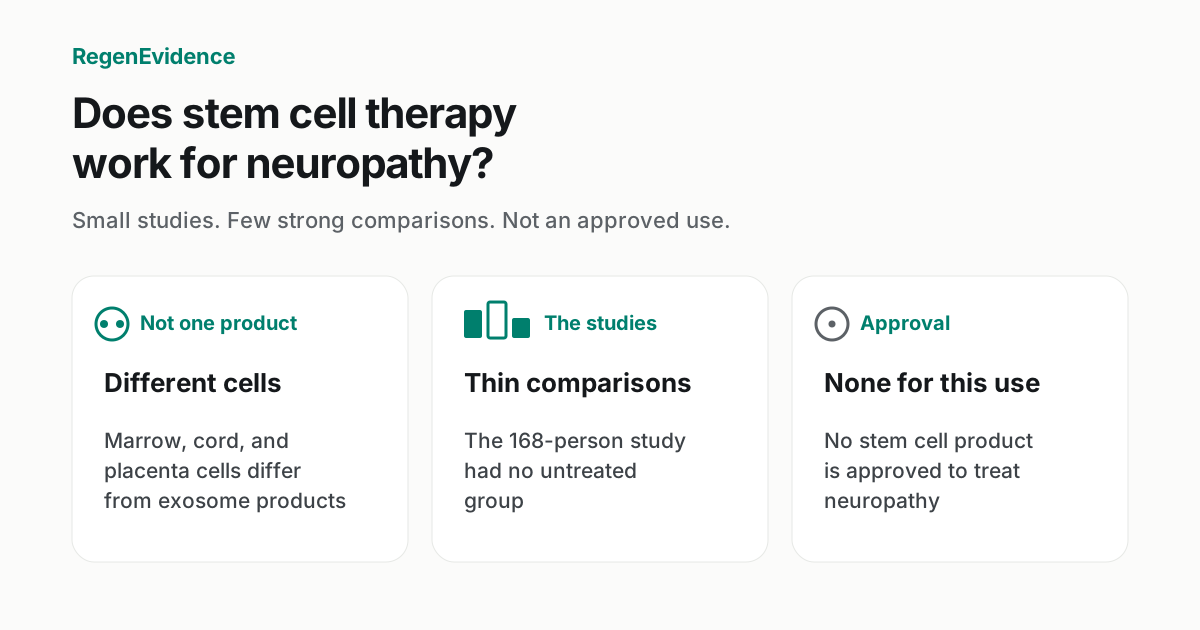
Not clearly. Studies in people are mostly small, in diabetic nerve damage, and few have strong comparisons. No stem cell product is FDA-approved for this.
The short answer
Not clearly. Stem cell therapy for neuropathy is not one treatment. Clinics and studies use different cells, and the human studies are mostly in nerve damage from diabetes. In the largest study in a 2024 review, scores and nerve tests changed from each person's own starting point, and there was no group that did not get the cells. A smaller randomized trial of a placenta-derived cell product found no significant change in nerve-fiber counts in the skin, or in three nerve exam and symptom scores. No stem cell product is FDA-approved for neuropathy.6781013
When diabetes is the cause, blood sugar care, foot protection, and certain pain medicines are the usual place to start. Those steps are separate from an investigational cell injection.34
What peripheral neuropathy is
Peripheral neuropathy means damage to the peripheral nervous system. Those nerves sit outside the brain and spinal cord. They carry signals in both directions. Sensory nerves bring in touch, temperature, and pain. Motor nerves tell muscles to move. Autonomic nerves run heartbeat, digestion, sweating, and other jobs you do not consciously direct.1
Symptoms depend on which nerves are hurt. They can include numbness, tingling, burning feet, pain, weakness, and trouble with balance. In many neuropathies the feet are affected first, because those nerve endings are farthest from the brain. Nerve pain is sometimes worse at night.1
Diabetes is the leading cause in the United States. A 2024 review of cell studies says diabetic peripheral neuropathy is diagnosed in approximately half of all diabetic patients. One clinic system's page says long-term high blood sugar damages the small blood vessels that bring oxygen and nutrients to nerves, and that nerve cells can die over time. Other causes include chemotherapy, alcohol, vitamin imbalance, infections, kidney or liver disease, pressure on a nerve, and some inherited conditions.126
The cause matters. A neurology institute's page says that sometimes, when the underlying cause is corrected, the neuropathy can resolve on its own as nerves recover and regrow. The clinic page says some neuropathies can be stopped or reversed if they are diagnosed and treated quickly, and that a person should see a provider at the first signs. That is about the cause. It is not a result for a cell product.12
These offers are not one treatment
One name covers several preparations. A finding for one does not apply to the others.610
The largest study in that review used bone marrow mononuclear cells from the person's own bone marrow. After a drug was given to move cells out of the marrow, marrow was taken from the hip and the cells were injected into the muscles of both thighs and both legs.67
A 2024 review says mesenchymal stromal cells are used in cell studies and are found in umbilical cord, dental pulp, and placenta. It says these cells can develop into bone, cartilage, and fat. Two of the seven human studies in that review used umbilical cord mesenchymal cells. Five used bone marrow mononuclear cells.6
A separate randomized trial used a placenta-derived cell product, injected into one leg.89
The FDA lists other products sold as regenerative treatment. The list includes stem cells, stromal vascular fraction (which it also calls fat-derived cells), umbilical cord blood, amniotic fluid, Wharton's jelly, and exosomes. Before approval, these products require FDA oversight in a clinical trial, whether they come from your body or someone else's.10
Exosomes are not a syringe of living cells. The 2024 review describes them as small packets that stem cells release. The reviewers left exosome studies, and studies that used stromal cells without calling them stem cells, out of the human tally. The exosome results they discuss are from diabetic mice and rats.6 There are currently no FDA-approved exosome products.1112
Which kinds of neuropathy
The human studies on this page are in diabetic peripheral neuropathy. In the 2024 review, six of the seven studies were in China and enrolled people with type 2 diabetes, using muscle injections. One study, of 10 people in Egypt, included type 1 and type 2 diabetes and gave bone marrow mononuclear cells into a vein. The 168-person bone-marrow study enrolled only type 2 diabetes. The placenta-cell trial also required type 2 diabetes.679
Chemotherapy-induced peripheral neuropathy is a different condition. A neurology institute's page calls it a disabling side effect of cancer treatment. Not every chemotherapy drug causes it, and not everyone who receives chemotherapy develops it. It may continue long after chemotherapy stops. The diabetic studies above did not enroll people for that reason.1
Immune neuropathies are different again. Guillain-Barre syndrome and chronic inflammatory demyelinating polyneuropathy are conditions in which the immune system harms nerves. The same page says intravenous immunoglobulin is a common treatment when autoantibodies are the cause, and that steroids, other immune-suppressing drugs, or plasma exchange are used for some inflammatory neuropathies. Plasma exchange removes immune proteins from the blood and returns the blood. Those treatments are not the muscle injections in the diabetic cell studies.1
What the comparisons show
A 2024 review searched through January 31, 2024. From 5,431 records it included seven studies, with 400 people. It counted both randomized and non-randomized controlled studies. Five used bone marrow mononuclear cells and two used umbilical cord mesenchymal cells. Six gave the cells by injection into muscle. One gave them into a vein. The reviewers rated three studies at low risk of bias and four as raising some concerns. They describe one randomized trial in the set, and they say that trial raised concerns about how people were assigned, about missing results, and about how results were measured and chosen. Their own limit statement says the review lacked large, high-quality controlled trials, and that the studies did not follow people long enough to judge later complications.6
The largest study in that review followed 168 adults with type 2 diabetes. Their mean age was 63.7 years, with a spread of 8.8 years. Diabetes had lasted a mean of 10.7 years, with a spread of 5.3 years. Nerve damage had lasted more than 2 years, with insufficient relief for at least 1 year from drugs the study counted as usual care, including an antioxidant, thiamines, and aldose reductase inhibitors. The authors say they did not set up a comparison group. They compared each person with that person's own earlier tests. Everyone also received intensive control of blood glucose, blood lipids, and blood pressure.67
They used the Toronto Clinical Scoring System. Its maximum is 19. Scores of 12 to 19 were graded as severe, and scores of 1 to 5 as no neuropathy. The mean score fell from 12.55 at the start (spread 2.19) to 9.68 at 1 month (spread 2.49) and to 8.47 at 3 months (spread 2.39). The authors say the drop was still present at 36 months. The share graded as severe fell from 69.6 percent to 28.6 percent at 1 month and to 0.6 percent at 36 months. The share graded as no neuropathy rose from 0 percent to 36.0 percent at 36 months. These are changes inside the treated group. They are not a difference from a group that did not get cells. The authors report P < 0.001 for the drops at 1 and 3 months, compared with each person's own starting score.7
Nerve signal speed was checked at the start, at 3 months, and at 12 months. Motor speed rose from 38.21 meters per second (spread 2.28) to 40.24 (spread 2.80) at 3 months and to 41.00 (spread 2.80) at 12 months. Sensory speed rose from 36.96 meters per second (spread 2.26) to 39.15 (spread 2.61) at 3 months and to 40.41 (spread 2.22) at 12 months. The paper also reports larger motor and sensory signals at those times, in microvolts: motor signals from 4.67 to 5.50 at 3 months and 5.68 at 12 months, and sensory signals from 4.29 to 5.14 at 3 months and 5.41 at 12 months. One person died 30 months after the injections. The authors report the death as a cardiovascular event. Six people were lost to follow-up.7
A randomized, placebo-controlled trial tested a placenta-derived cell product in people with diabetic peripheral neuropathy from type 2 diabetes. The registry lists 26 people enrolled. Injections went into one leg, below the knee and above the ankle, on days 1, 29, and 57. Each visit used 15 injections of 0.30 mL. People were assigned to 3 million cells, 30 million cells, or a placebo. A placebo is an inactive comparison. The main measure was the change in nerve fibers in a skin sample at 6 months. The trial report says the product was well tolerated at both doses, and that no significant changes were noted in that skin count in the treated or untreated leg, or in three nerve exam and symptom scores. The trial followed the skin count for up to a year, with 6 months as the main time point.89
A separate trial of umbilical cord mesenchymal cells for moderate to severe diabetic neuropathy is listed as recruiting. It estimates 140 adults, ages 18 to 80, in China. Cells would be injected into the calf muscles of both legs on day 0, day 7, and day 28, plus usual care, and compared with usual care alone. The listing is not blinded, so people and clinicians would know who got the cells. The main symptom score is at 24 weeks, with safety follow-up to 104 weeks. The estimated completion date is in 2028. A page on a trial registry does not mean a benefit has been shown, and it does not mean the product is legally marketed.1014
What a procedure involves
The steps depend on the product. What follows is how the studies were done, not a schedule for one person.79
In the 168-person study, people got a daily injection under the skin for 3 days, meant to move cells out of the bone marrow. Then 200 mL of bone marrow was taken from the back of the hip, under anesthesia and sterile conditions. The cells were separated and injected into both thighs and both legs, at 50 spots, 1 mL at each spot, spaced on a 2 cm by 2 cm grid, from 1 to 5 cm deep. Visits were planned at 1, 3, 6, 12, 18, 24, and 36 months. Nerve conduction tests were repeated at 3 and 12 months.7
In the placenta-cell trial, each person got those 15 small injections in one leg on three days about a month apart. The registry measures the main result over 6 months and tracks side effects for up to about 2 years.9
The 2024 review's other studies mostly used muscle injections as well. One used a vein. Cell source and route differed across the seven, so one study's steps are not the procedure at every office.6
Risks that are known
In the bone-marrow study, the authors report no adverse events from the marrow draw. Right after the injections they report no infection, bleeding, or allergic reaction. During follow-up they report no rejection and no malignancy. It is one group, without a comparison group, and one person died of a cardiovascular event during those months.7
The 2024 review summarizes complications across its seven studies as pain and swelling at the injection sites, which disappeared in a few days. The reviewers also say the included studies did not have long-term follow-up for later complications.6
The FDA lists other risks for unapproved regenerative products, including stem cells, fat-derived cells, cord blood, and exosomes. The material can come from your body or from someone else. The list includes bacterial infection, including life-threatening blood infection, unwanted immune reactions, reactions where tissue is taken or injected, cells moving elsewhere or growing in an unintended way, and contamination with bacteria, viruses, or mold during preparation. The agency has also received reports of blindness and tumor formation with some products in this group. Those reports are not a rate for every muscle injection. The diabetic studies above did not report blindness or tumors. The reports do show that serious harm has happened with unapproved products sold as regenerative treatment.10
For exosomes, the FDA in 2019 reported serious adverse events in patients in Nebraska who were treated with unapproved products marketed as containing exosomes.12
If you are charged for stem cells, fat-derived cells, cord blood, or exosomes outside a clinical trial, the FDA says you are likely being deceived and offered a product illegally. A page on a trial registry, or a claim that a firm registered with the FDA, does not mean the product is legally marketed.10
How this compares with usual care
Usual care depends on the cause. It is a different path from an investigational cell product.14
For diabetic nerve damage, a 2026 diabetes standard says no specific treatment is currently available to reverse the underlying nerve damage. It says optimal glucose management can prevent this neuropathy in type 1 diabetes and may modestly slow it in type 2 diabetes, but it does not reverse the loss of nerve cells. It also says managing weight, blood pressure, and lipids can help prevent the neuropathy from getting worse in type 2 diabetes. A large medical center's page says checking blood sugar, if you have diabetes, might help the neuropathy. A neurology institute's page says keeping blood glucose at safe levels may reduce or eliminate symptoms of diabetic neuropathy.134
The diabetes standard recommends four kinds of medicine as the first drug treatment for nerve pain in diabetes: gabapentinoids, serotonin-norepinephrine reuptake inhibitors, tricyclic antidepressants, and sodium channel blockers. It says combinations of these can add relief. It says opioids, including tramadol and tapentadol, should not be used for this pain except in rare circumstances. A 2022 neurology guideline says clinicians should offer those same four classes to reduce pain from painful diabetic neuropathy, and should not use opioids for that pain. It says the classes had similar effects on pain, so the choice depends on side effects, other illnesses, cost, and what the person prefers. It says a medicine can be judged a failure when it has been adjusted to a dose already shown to help, for about 12 weeks, without a meaningful drop in pain, or when side effects outweigh the benefit. That is a description of the guideline. It is not a dose for one person.45
A large medical center's page names gabapentin and pregabalin among medicines that often improve nerve pain, with drowsiness and dizziness among the side effects. It says duloxetine, venlafaxine, and desvenlafaxine might improve nerve pain caused by diabetes, and that amitriptyline and nortriptyline can help pain. The neurology institute's page names duloxetine, nortriptyline, gabapentin, and pregabalin among common medicines for nerve pain, and says opioids are not recommended for pain from peripheral neuropathy.13
Foot protection is part of diabetic care, not part of a cell study. The diabetes standard says to do a full foot exam at least once a year to look for risks of ulcers and amputation. The medical-center page says to check daily for blisters, cuts, or calluses, to wear soft socks and padded shoes, and to quit smoking because smoking harms circulation. It says regular exercise, such as walking three times a week, can lower neuropathy pain, improve strength, and help manage blood sugar, and that too much alcohol can make neuropathy worse.34
The same page lists physical therapy when weakness or balance is a problem, and braces, a cane, or a walker when they are needed. It also lists spinal cord stimulation: implanted devices that send low-level electrical impulses that can block pain signals. That is a device procedure. It is not a stem cell injection.3
For a compressed nerve, surgery is sometimes used to take pressure off. For an immune neuropathy, the immune treatments above are the ones the neurology page describes. A cell injection studied in diabetic neuropathy does not replace those steps.13
Who the studies left out
The bone-marrow study enrolled adults ages 30 to 80 with type 2 diabetes and nerve damage for more than 2 years. It left out severe liver or kidney dysfunction, clotting or blood disorders, neuropathy from another cause, foot ulcers, limb deformity, pregnancy, and a malignancy in the prior 5 years. Those rules describe who was studied. They are not a decision for one person.7
The placenta-cell registry required type 2 diabetes and age at least 18. It left out pregnancy and breastfeeding, type 1 diabetes, a past diabetic foot ulcer, other causes of neuropathy, people already taking opioids for the neuropathy, advanced neuropathy measured by an absent sural sensory signal, and hemoglobin A1c over 10 percent at screening.89
The recruiting umbilical-cord study, as listed, also leaves out pregnancy, breastfeeding, a plan to become pregnant within 2 years, active cancer, severe uncontrolled infection, and foot ulcers severe enough that the listing says a leg injection is not possible. A listing is a plan for a study. It is not care advice.14
Cost and insurance
This page does not list a price. Charges are not the same in every office. Ask your plan, in writing, whether it pays for the exact procedure, the visit, and follow-up. Ask the clinic what is included before you agree. If the offer is a study, ask which bills the study pays and which it does not.10
Cell and exosome products are not approved for neuropathy. If you are charged for stem cells, fat-derived cells, cord blood, or exosomes outside a clinical trial, that is the situation the FDA warns about.1011
Questions to ask a clinician
What is causing my neuropathy? Is it diabetes, a medicine such as chemotherapy, pressure on a nerve, an immune condition, or something else that has its own treatment?12
What would actually be used: my own bone marrow cells, umbilical cord cells, placenta-derived cells, fat-derived cells, cord blood, Wharton's jelly, amniotic fluid, or exosomes? Would they be injected into muscle or given into a vein?67910
Is any stem cell or exosome product approved by the FDA for neuropathy? If this is a study, who oversees it, and can I read the consent form before I pay? A registry page is not an approval.101213
What did a comparison show for this exact preparation, in people whose neuropathy looks like mine, and how long were they followed? Was there a group that did not get the cells?678
What problems have occurred in people treated here, including infection, and who answers if one starts after I go home?710
How does that compare with glucose care, foot care, the pain medicines recommended for diabetic nerve pain, physical therapy, or, if a clinician raises it, a stimulator device?345
Will my health plan pay any of this? If it will not, what does the full plan include?10
The bottom line
Stem cell therapy has not been shown to be a reliable treatment for neuropathy. The name covers different products. The largest study in that review, in diabetic nerve damage, had no comparison group, and the changes it reports are from each person's own starting tests while blood sugar, lipids, and blood pressure were also treated intensively. A smaller randomized trial of a placenta-derived product did not show a significant change on the nerve-fiber skin count or on three nerve exam and symptom scores. A 2024 review of seven studies says the human evidence still lacks large, high-quality controlled trials and long follow-up. No stem cell product is FDA-approved for neuropathy. There are currently no FDA-approved exosome products. Blood sugar care, foot protection, and the pain medicines named in diabetes and neurology guidance are the established steps for diabetic nerve pain.456781011
This page is for learning. It is not personal medical advice.
Sources · 14
- 1Source 1(opens in a new tab)
Patient page
- 2Source 2(opens in a new tab)
Patient page · 2026
- 3Source 3(opens in a new tab)
Patient page · 2026
- 4Source 4(opens in a new tab)
Care standard · 2026
- 5Source 5(opens in a new tab)
Guideline summary · 2022
- 6Source 6(opens in a new tab)
Journal review · 2024
- 7Source 7(opens in a new tab)
Clinical study · 2019
- 8Source 8(opens in a new tab)
Trial summary · 2021
- 9Source 9(opens in a new tab)
Trial registry
- 10Source 10(opens in a new tab)
Regulator page · 2021
- 11Source 11(opens in a new tab)
Regulator page · 2020
- 12Source 12(opens in a new tab)
Regulator page · 2019
- 13Source 13(opens in a new tab)
Regulator page · 2024
- 14Source 14(opens in a new tab)
Trial registry
Ask a question in your own words. A question stays on the ask page. It is not added to this article or to a share link.
For learning only. Not medical advice. Talk to your doctor.