Is stem cell therapy safe?
Published .
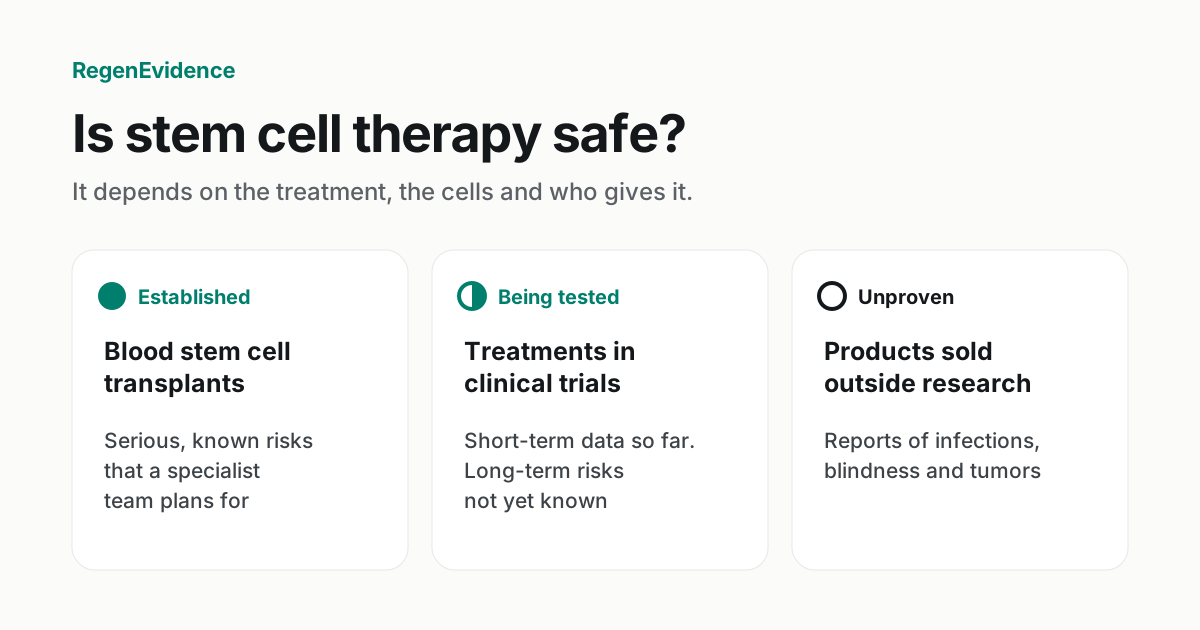
It depends on the treatment. Blood stem cell transplants are established but risky. Most other uses are experimental, and unproven products have caused harm.
The short answer
It depends on which treatment you mean. Some stem cell treatments are established medical care. The best known is a blood-forming stem cell transplant. It is used for certain blood and immune system disorders, and to rebuild the blood system after some cancer treatments. Even that carries serious risks, which a specialist team plans for.15
Most other stem cell treatments are still experimental. In a 2026 review of 42 trials that gave one type of donor cord-tissue cell into a vein, the only clear extra side effect was fever soon after treatment. Long-term safety is not yet known, and those results do not apply to joint injections or to other cell products.7 For knee arthritis injections, serious harms were rarely reported, but the risk of other harms is unknown.8 Unproven products sold outside of research have caused serious harm, including blood and joint infections and blindness.4910
So there is no single answer. A more useful question is: how safe is this exact treatment, for my condition, given by this team?12
What counts as stem cell therapy?
Stem cell therapy uses stem cells, or cells made from them, to treat illness. The name covers very different treatments:
A hospital transplant of blood-forming stem cells, from your own body or a donor.15
Cells taken from your own fat or bone marrow, then injected into a joint or another part of the body.14
Donor products made from umbilical cord blood, cord tissue or other birth tissue.4
Clinics also sell related products, such as exosomes, under the same "regenerative" label.4 Each of these has its own risks. Safety data for one does not carry over to another.1
Are treatments with my own cells safer?
Not automatically. In theory, your immune system will not attack your own cells. But the steps used to collect, process and return them still carry risk.1 Cells can pick up bacteria or viruses when they are taken out and handled. Processing in a lab can change how cells behave, including how they control their growth. And cells may be injected into places where they do not belong.1
Donor cells add other concerns. Your immune system may react to them.24 Products that are not tested properly can also pass on infections such as hepatitis or HIV.4 Some stem cells made in a lab can overgrow and form tumors if they are not carefully guided into the right type of cell first.1
What are the risks of a stem cell transplant?
A blood-forming stem cell transplant is a major treatment for a serious illness. Side effects can come from the strong chemotherapy or radiation given before the transplant, or from the transplant itself.6 Some happen soon after. Others can appear months or even years later.5
Common problems include hair loss, a sore mouth and throat, tiredness, a higher chance of infection, and blood clots. Some treatments given before a transplant can affect fertility.6 It can take 6 months to a year for the immune system to recover.5
With donor cells, the new immune cells can attack the body. This is called graft-versus-host disease. It ranges from mild to life-threatening. Up to half of people who get donor cells develop the long-lasting form.5 Your care team should explain these risks before treatment.6
What do clinical trials show about safety?
Many trials are testing a type of cell called mesenchymal stromal cells, which researchers study for their effects on inflammation. A review published in 2026 pooled 42 randomized trials with 2,280 adults who got these cells, taken from umbilical cord tissue, into the bloodstream.7
Fever was more than twice as common in people who got the cells than in those who did not. The review found no clear rise in infections, blood clots, cancer or deaths. No trial was stopped early for safety reasons.7
There are limits. Only four trials checked for cancer more than a year later, and cancer can take longer to appear. The authors said the cells look safe enough to keep studying, not that they are proven safe as treatment.7 The review did not include joint injections.7 For knee arthritis injections, serious harms were rarely reported, but any joint injection carries a small risk of joint infection. The risk of other harms is unknown.8
Trial results apply to the products that were tested. They do not show that a product sold at a clinic, made in a different way, is safe.49
What harms have unproven treatments caused?
US regulators list serious safety concerns with unapproved stem cell and related products. These include blindness, tumors, nerve problems, life-threatening blood infections, and immune reactions. Cells can also move to other parts of the body and grow into the wrong type of tissue.4
Two published reports show what can go wrong:
Infections from contaminated products. In one US investigation, 20 people in 8 states developed bacterial infections after getting cord blood products sold as stem cell treatment. Most were seeking help for pain, arthritis or injuries. All but one needed hospital care. Some had infections in the injected joint or spine, and some in the blood. When unopened vials were tested, 22 out of 34 were contaminated.9
Vision loss after eye injections. Three patients with an eye disease called macular degeneration had their own fat-derived cells injected into both eyes at a US clinic. All three had severe vision loss. A year later, their vision ranged from very poor to no light perception at all.10
Reports like these show that serious harm happens. They cannot tell us how often it happens.4
Hidden risks beyond side effects
Problems from an unproven treatment can make your condition harder to manage.1 Spending time on a treatment that does not help can also delay care that is known to help.4
An unproven treatment may make you unable to join a clinical trial later.12 And insurance usually does not pay for experimental treatment. You may also have to pay for emergency care if something goes wrong.12
How can I judge the safety of a specific offer?
A leading stem cell research society lists these warning signs:3
The clinic relies on patient stories instead of controlled studies.
The same cells are offered for many unrelated diseases.
The source of the cells, or how they will be given, is not clearly written down.
You are told there is no risk. Every treatment has some risk.
You are asked to pay to be in a study. This is not usual for clinical trials.13
You are told approval from regulators is not needed.
In the US, cell products that need FDA approval are meant to be given only in a clinical trial with FDA oversight until they are approved. A narrow exception can apply when your own tissue is removed and put back into you during the same surgical procedure. That exception is not an approval and does not show that a procedure is safe.411 A listing on ClinicalTrials.gov, or a company's registration with the FDA, does not mean a product is legally sold or safe.4 You should not feel rushed or pushed into a decision. Getting a second opinion from a qualified doctor who knows your condition is a good idea.2
Questions to ask before you decide
Where do the cells come from? Are they mine or a donor's?2
What are the risks of the procedure, both right away and in the long term?2
Is this treatment approved by a regulator for my specific condition?2
What happens if I have a bad reaction? Who do I call, and who will give emergency care?2
Is the clinic ready to handle an emergency, such as a serious allergic reaction?2
What follow-up will I get, and for how long?2
Could this treatment keep me out of a clinical trial later?2
What would emergency care cost if something goes wrong?2
Can I have a written consent form that explains the risks?2
When to get help after treatment
Ask your team before treatment which symptoms need urgent care and who to call.2 After a transplant, contact your team right away if you have a fever or other signs of infection.5 Also get urgent help for pain, swelling and warmth in an arm or leg, or sudden shortness of breath or chest pain.6
If you had a bad reaction after a regenerative treatment in the US, you can report it to the FDA's safety reporting program.4
The bottom line
Blood-forming stem cell transplants are established care, but they are serious treatments with real risks. Most other stem cell treatments are still being tested. For one well-studied cell type, short-term safety in careful trials looks favorable so far, but long-term risks are not known. Unproven products sold outside research have caused serious harm.147
Before any stem cell treatment, talk with a doctor who knows your health history and your condition. This article is for general education. It is not medical advice.2
Sources · 11
- 1Source 1(opens in a new tab)
Patient guide
- 2Source 2(opens in a new tab)
Patient guide
- 3Source 3(opens in a new tab)
Patient guide
- 4Source 4(opens in a new tab)
Regulator page · 2021
- 5Source 5(opens in a new tab)
Patient page · 2026
- 6Source 6(opens in a new tab)
Health service page · 2026
- 7Source 7(opens in a new tab)
Research review · 2026
- 8Source 8(opens in a new tab)
Review summary · 2025
- 9Source 9(opens in a new tab)
Public health report · 2021
- 10Source 10(opens in a new tab)
Case report · 2017
- 11Source 11(opens in a new tab)
Federal regulation
Ask a question in your own words. A question stays on the ask page. It is not added to this article or to a share link.
For learning only. Not medical advice. Talk to your doctor.