What is stem cell therapy, and what can it help with?
Published .
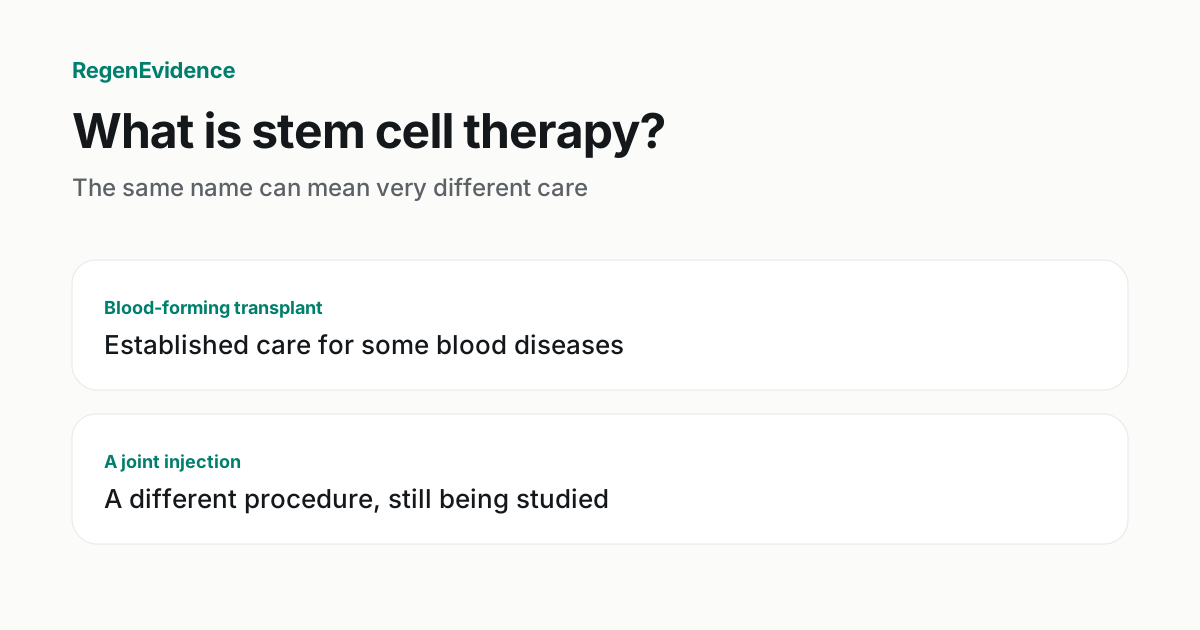
Stem cell therapy is not one treatment. Blood-forming transplants are established care for some serious illnesses. Many other uses are still being tested.
It is not one treatment
Stem cell therapy uses stem cells, or cells made from them, to treat disease. It is not one treatment: blood-forming stem cell transplants are established care for certain serious illnesses, while many other uses are still being tested. Whether a treatment can help depends on the condition, the cells used and how they are given.12
What are stem cells?
Stem cells can make more cells like themselves. They can also develop into cells with specific jobs. But different stem cells have different abilities. Blood-forming stem cells make blood cells; they are not a ready-made repair kit for every part of the body.13
For example, blood-forming stem cells produce red blood cells that carry oxygen, white blood cells that fight infection, and platelets that help stop bleeding. These stem cells are found in bone marrow, the soft tissue inside bones. Cells used for treatment can also be collected from blood or donated umbilical cord blood.1
Researchers are studying other types of cells to find out whether they can replace damaged cells or change signals involved in inflammation and repair. A promising result in a laboratory does not show that a treatment will help a person.24
What it can help with: blood disorders
Blood-forming stem cell transplants are used for conditions such as leukemia, lymphoma, multiple myeloma and aplastic anemia, a disease in which the bone marrow does not make enough blood cells.1
In cancer care, a transplant often restores blood-cell production after high-dose treatment has damaged or destroyed those cells. With donor transplants for leukemia, donor immune cells may also help attack remaining cancer cells. The goal and chance of success depend on the disease and the person's health. A transplant is a major treatment, not a simple injection for general wellness.1
What it can help with: knee arthritis
Cell injections for knee arthritis are different from blood stem cell transplants. Researchers are testing whether these injections can reduce pain and make movement easier. A review published in 2025 found that they may provide small improvements in pain and daily function for up to six months compared with a placebo injection, which did not contain the cell treatment. Confidence in that finding was low. The studies used different cell preparations, and important results were missing. Whether the injections slow damage inside the knee remains uncertain.4
These findings do not establish that a shot can rebuild worn cartilage or prevent knee replacement. They also cannot tell us whether a different cell treatment will help back pain or another condition. Each use needs its own evidence.24
Many treatments promoted for joint pain and other unrelated conditions remain unproven. That means their benefits and risks have not been established well enough for those uses—not that all stem cell research has failed.2
Which treatments are approved in the United States?
The US Food and Drug Administration (FDA) approves specific cell treatments for specific uses. Approval for one illness does not establish the same benefit for another illness. This overview is not a complete list of approved cell treatments.56
FDA patient guidance says stem cell products have not been approved to treat knee arthritis or back pain.5 Approval, evidence of benefit, legal availability and insurance coverage are separate questions. A use outside an approved label is not the same situation as selling an unapproved cell product. Ask for an explanation of the exact treatment's status rather than relying on the phrase “FDA-registered.”56
What happens during treatment?
There is no single stem cell procedure. The first step is an assessment of the diagnosis, treatment goals and other options. For a blood stem cell transplant, the team also checks whether the person's health can tolerate the treatment and whether donor cells are needed.1
Cells may come from the person receiving treatment or from a donor. Blood stem cells can be collected from the bloodstream using a machine that separates them from the rest of the blood. Bone marrow collection uses a needle placed into a bone. Before transplantation, patients usually receive chemotherapy, sometimes with radiation. The stem cells are then given through a tube into a vein, much like a blood transfusion.17
A cell injection being studied for a painful joint involves a different process. Depending on the study, cells may be collected from bone marrow or fat, or supplied from donor tissue. They may be processed in different ways before injection. The cell source, preparation and route matter: results from one procedure cannot simply be applied to another.48
How long does recovery take?
Recovery from a blood stem cell transplant can take months. Blood counts and the immune system need time to recover, and patients need close monitoring for infections and other problems. Some effects can last much longer.1
A joint injection does not involve the same recovery as a transplant. In knee-cell research, pain, swelling and bruising can occur where cells are collected or injected.8 There is no reliable recovery timetable for everything called stem cell therapy. The team should explain the expected follow-up, activity limits and warning signs for the particular procedure.1
What are the risks, and who can have treatment?
Risks depend on the treatment, not just whether the cells are your own. A blood stem cell transplant and the treatment given before it can cause serious infection, bleeding, organ damage and fertility problems. With donor transplants, donor immune cells can attack healthy tissues—a complication called graft-versus-host disease.1
Cell collection and injections have their own risks, including pain, bleeding and infection. Long-term safety for many uses still being studied is uncertain. FDA has received reports of severe harm from unapproved regenerative products, including infections, unwanted tissue growth and blindness. These reports concern particular unapproved products and procedures; they do not give one risk rate for all stem cell treatments.45
Eligibility also varies. A specialist considers the illness, other available treatments, previous care and overall health. There is no general test that makes someone a suitable candidate for every form of stem cell therapy.1
What are the alternatives?
Alternatives depend on the diagnosis. In blood cancer care, a transplant team compares transplantation with other treatments for that cancer.1
For knee arthritis, options may include exercise and physical therapy, weight management when appropriate, pain medicines, supports such as a brace, and selected injections. Joint replacement may be considered when symptoms remain severe despite other care. These options have different benefits and risks; they are not interchangeable with a cell injection.9
What about cost and insurance?
There is no single price or coverage rule for stem cell therapy. An established transplant involves much more than the day cells are given. Testing, hospital care, medicines, follow-up and sometimes travel or accommodation can all affect the total. Insurance may cover some transplant care for certain cancers, but the details depend on the plan.1
Before agreeing to any proposed treatment, ask for a written explanation of all charges and check coverage directly with the insurer for that exact procedure and diagnosis. A treatment being available to buy does not show a benefit, approval for your condition, or coverage.15
What should I ask before deciding?
Bring these questions to your treating clinician.
What exactly is the treatment, and where do the cells come from?
What benefit has it shown for my condition—less pain, better movement, control of disease or something else?
How does it compare with the other options available to me?
What are the short- and long-term risks, and who will manage a complication?
What will treatment and follow-up involve? How might they affect work or daily life?
What will I be charged, and what has my insurer agreed to cover?
If this is research, what is the study name and identifier, who oversees it, and can I read the consent information?
A listing on ClinicalTrials.gov does not mean a treatment has shown a benefit or has FDA approval. Study information is something to discuss with a clinician who understands your condition, not a substitute for that conversation.5
Stem cell therapy has an established role in some serious diseases and an uncertain role in many other conditions. The useful question is not simply “Do stem cells work?” It is “What can this particular treatment do for this particular illness?”12
This article provides general education, not personal medical advice.
Sources · 9
- 1Source 1(opens in a new tab)
Patient page · 2023
- 2Source 2(opens in a new tab)
Patient page
- 3Source 3(opens in a new tab)
Patient page
- 4Source 4(opens in a new tab)
Review abstract · 2025
- 5Source 5(opens in a new tab)
Regulator page · 2021
- 6Source 6(opens in a new tab)
Regulator page
- 7Source 7(opens in a new tab)
Patient page · 2026
- 8Source 8(opens in a new tab)
Trial report · 2023
- 9Source 9(opens in a new tab)
Patient page
Ask a question in your own words. A question stays on the ask page. It is not added to this article or to a share link.
For learning only. Not medical advice. Talk to your doctor.